Modeling of Compound Coastal Flooding
Published: 2026-08-21 11:59:02Last update: 2026-08-24 15:27:33
Understanding and predicting compound coastal flooding remains one of the most challenging problems in hydrologic and coastal sciences. Flooding in coastal environments usually emerges from the interaction of tides, storm surge, waves, river discharge, precipitation, groundwater, and evolving sea levels, often acting across multiple spatial and temporal scales (Green et al). These complexities have motivated remarkable advances in numerical modeling, observational systems, machine learning, and conceptual frameworks. Yet, despite substantial progress within each modeling paradigm, research has largely evolved along parallel trajectories rather than through systematic integration. As highlighted by recent perspectives, continued reliance on individual modeling approaches beyond their intended strengths risks limiting scientific progress and preventing the community from fully leveraging complementary capabilities (Nazari et al). The next generation of coastal flood prediction therefore lies not in replacing existing methods, but in strategically combining them.
Recent studies have emphasized that hybrid modeling should be viewed as a distinct scientific framework rather than simply coupling multiple models together. By integrating computational, statistical, observational, and data-driven approaches, hybrid systems capitalize on the unique advantages of each while mitigating their individual limitations. Emerging classifications, including sequential, feedback, and ensemble hybrid architectures, provide a useful foundation for comparing different integration strategies and identifying where information should flow between component models (Radfar et al). This perspective moves the field beyond isolated model development toward flexible modeling ecosystems that are both scientifically rigorous and operationally practical.
The importance of such integration is evident in recent efforts to develop comprehensive coastal forecasting systems. Large-scale modeling frameworks now routinely combine multiple hydrodynamic, wave, hydrologic, and atmospheric models to simulate the interactions among coastal, fluvial, and pluvial flooding processes within unified computational environments (i.e. Green et al. (2026), Zhao et al, and Sun et al). These integrated systems represent a major step toward physically consistent prediction of compound hazards across diverse coastal landscapes. Their strength lies in faithfully resolving complex physical interactions that cannot be represented by individual models alone. However, this level of physical realism comes at a substantial computational cost, limiting their application for probabilistic analyses, long-term climate assessments, uncertainty quantification, ensemble forecasting, and real-time decision support where thousands of simulations may be required (Jafarzadegan et al).
At the other end of the spectrum, recent years have witnessed rapid advances in data-driven techniques for flood prediction. By leveraging large observational and simulation datasets, these approaches have demonstrated remarkable capability in learning complex nonlinear relationships while producing forecasts with exceptional computational efficiency. However, purely data-driven models remain fundamentally constrained by the information they can provide (i.e. hazard level at gauged locations) and the information contained within their training datasets. Their predictive skill often deteriorates when confronted with unprecedented events, evolving climate regimes, or hydrodynamic conditions that lie outside the historical record, limiting their reliability for extrapolation and high-impact decision making (Irish, Ragno, Bahmanpour). Equally important, many machine learning models provide limited physical interpretability, making it difficult to diagnose the governing processes underlying their predictions or establish confidence for applications involving rare extremes (Bao et al). Recent comparative assessments further demonstrate that model architecture strongly influences generalization, with sequence-aware designs such as CNN–LSTM substantially outperforming conventional neural networks for unseen flood events, while purely spatial architectures often struggle to reproduce the temporal evolution of compound flooding (Fen et al, and Daramola et al). These findings reinforce that statistical accuracy alone is insufficient and that robust flood prediction requires learning strategies capable of representing both the spatial and temporal dynamics of physical flood processes (Wang et al., and Yarveysi et al).
Hybrid methodologies have consequently emerged as a promising pathway for overcoming these complementary limitations by integrating the strengths of process-based understanding with the efficiency of machine learning. Rather than treating physics-based and data-driven models as competing paradigms, hybrid frameworks increasingly embed physical knowledge directly within learning architectures through transfer learning, physics-informed loss functions, conservation constraints, and adaptive coupling strategies. Recent studies demonstrate that transfer learning can substantially reduce computational demands while improving model portability across diverse coastal environments, provided that physical understanding is incorporated into the learning framework (Daramola et al). More recently, physics-informed neural networks have shown that explicitly enforcing governing equations, including mass and momentum conservation, substantially improves predictive skill, physical consistency, and robustness under data-scarce conditions while maintaining inference speeds orders of magnitude faster than conventional numerical models (Yang et al., and Radfar et al). Hybrid statistical-dynamical frameworks are transforming regional and long-term flood hazard assessments. Recent developments combine stochastic generators of compound flood drivers with process-based hydrodynamic simulations and surrogate machine learning models capable of reproducing complex flood responses at only a fraction of the computational expense (see Wang et al., Emmanouli et al., and Ricondo et al. for example). Related reduced-order frameworks replace repeated high-resolution simulations with statistical emulators trained on carefully selected physics-based model outputs, enabling rapid mapping of coastal, fluvial, and pluvial flooding over large ensembles of environmental conditions. These approaches dramatically expand the range of questions that can be addressed, from centennial-scale hazard assessments and climate adaptation planning to probabilistic risk analysis and operational forecasting.
Taken together, these developments suggest that the future of compound coastal flood modeling will not be defined by increasingly sophisticated individual models, but by thoughtfully designed hybrid frameworks that integrate complementary sources of information across observations, numerical simulations, statistical inference, and machine learning. Such systems have the potential to achieve an effective balance between physical realism, computational efficiency, predictive accuracy, and interpretability. As coastal hazards intensify under a changing climate and the demand for actionable flood information continues to grow, hybrid modeling provides a compelling roadmap toward scalable, transferable, and scientifically robust solutions capable of supporting both fundamental research and real-world decision making.
Heat and Humidity Extremes (covering years 2023-26)
Published: 2026-07-14 05:55:31Last update: 2026-08-21 11:54:04
? State of the Science Blog by Colin Raymond (UCLA)
The last few years have seen considerable progress toward identifying the atmospheric processes that control the most intense humid-heat episodes1,2 and their modulation by large-scale modes of variability. In some cases, detailed timelines are starting to be sketched out3; however, regional dynamics outside the typical focus regions of South and East Asia, the Persian/Arabian Gulf, and eastern North America largely remain unexplored. Oceanic contributions to humid heat are gaining attention for marine heat waves4 and the global annual mean5, but ocean and sea-breeze dynamics remain a notable blind spot. Debate also continues about where and when evapotranspiration amplifies (or dampens) humid heat, seemingly partly due to differences in analysis resolution6-10.
The physical properties of water vapor contribute to several other forms of compounding with a burst of recent research energy, including ‘day-night’ humid-heat events11 and correlations with heavy precipitation12-14, severe storms15, and poor air quality16. In some cases, despite strong suppositions, unambiguously demonstrated linkages with impacts remain elusive. Similarly, we seem little closer to resolving the split-view understanding of the additive importance of humidity from physiological versus epidemiological perspectives as we were when the problem was so sharply articulated by ref. 17.
One of the newer and more sociophysically integrated developments has been the conception of low-latitude humid heat as a chronic phenomenon, one for which many physical- and social-science framings are ineffective (ref. 18 and references therein). Humid heat’s labor effects have been studied rather extensively in past years and recently19, but still largely with models that leave uncertainties around individual-level exposures, sociocultural differences, and adaptive practices of the sort often noted in media coverage.
A growing body of evidence has refined the temperature-humidity combinations at which deadly humid heat occurs20, typically lowering inferred mortality and morbidity thresholds21-23; several papers have applied these revised thresholds to observations and model projections24,25, but the far-reaching implications for adaptation, mitigation, equity, and physical-process research have only begun to be explored26. Translating certain tantalizing research findings, such as the high predictability of humid heat from particular initial conditions27,28, into operational forecasts and early warnings represents another major opportunity for rapid near-term advance.
The impending incorporation of humidity into widely used AI weather and climate models offers significant possibilities for spurring model assessment and improvement, and for enabling ever-higher-resolution examinations of humid-heat patterns and processes. While microscale modeling of humid heat has been done for select cities29 with global work underway, widespread validation at such scales remains elusive30,31. In general, intercomparison among observed and model datasets for humid heat remains an important frontier given large discrepancies in the historical period for both extreme values32 and trends33.
- Li, F., & Tamarin-Brodsky, T. (2026). Sci. Adv.doi:10.1126/sciadv.aea8453.
- Duan, S., et al. (2024). Nat. Geosci. doi:10.1038/s41561-024-01498-y.
- Saha, M., et al. (2026). Geophys. Res. Lett. doi:10.1029/2025gl118998.
- Okajima, S., et al. (2025). AGU Adv. doi:10.1029/2025av001673.
- Chu, H., et al. (2024). Geophys. Res. Lett. doi:10.1029/2023gl106617.
- Wu, Y., & Wang, J. (2026). Atmos. Ocean. Sci. Lett. doi:10.1016/j.aosl.2026.100793.
- Chagnaud, G., et al. (2025). Geophys. Res. Lett. doi:10.1029/2024gl112467.
- Chakraborty, T., et al. (2025). Nat. Geosci. doi:10.1038/s41561-024-01613-z.
- De Hertog, S., et al. (2025). Earth’s Fut. doi:10.1029/2024ef005021.
- Yao, Y., et al. (2025). Nat. Commun. doi:10.1038/s41467-025-64375-1.
- Guo, Y., & Fu, Z. (2024). Environ. Res. Lett. doi:10.1088/1748-9326/ad4c7e.
- Jackson, L., et al. (2025). Nat. Commun. doi:10.1038/s41467-025-58694-6.
- Johnson, S., et al. (2024). Environ. Res. Lett. doi:10.1088/1748-9326/ad7edc.
- Zhang, Z., et al. (2024). Nat. Commun. doi:10.1038/s41467-024-51778-9.
- Wang, P., et al. (2023). J. Clim. doi:10.1175/jcli-d-22-0279.1.
- Ajay, P., et al. (2023). Environ. Res. Clim. doi:10.1088/2752-5295/acf7e2.
- Baldwin, J., et al. (2023). Environ. Health Persp. doi:10.1289/ehp11807.
- Cruz, M., et al. (2025). Environ. Res. Clim. doi:10.1088/2752-5295/adc827.
- Masuda, Y., et al. (2024). One Earth. doi:10.1016/j.oneear.2024.02.001.
- Guo, Q., et al. (2024). PNAS Nexus. doi:10.1093/pnasnexus/pgae290.
- Filingeri, D., & Esteves, N. (2025). Exper. Physiol. doi:10.1113/ep092242.
- Meade, R., et al. (2025). Proc. Nat. Acad. Sci. USA. doi:10.1073/pnas.2421281122.
- Fan, Y., & McColl, K. (2024). Commun. Earth Environ. doi:10.1038/s43247-024-01930-6.
- Perkins-Kirkpatrick, S., et al. (2026). Nat. Commun. doi:10.1038/s41467-026-70485-1.
- Matthews, T., et al. (2025). Nat. Rev. Earth Environ. doi:10.1038/s43017-024-00635-w.
- Ivanovich, C., et al. (2024b). J. Atmos. Sci. doi:10.1175/jas-d-23-0072.1.
- Zhang, Y., et al. (2024). Geophys. Res. Lett. doi:10.1029/2023gl106990.
- Li, J., et al. (2024). Geophys. Res. Lett. doi:10.1029/2024gl112847.
- Li, X., et al. (2024). Environ. Res. Lett. doi:10.1088/1748-9326/ad6c64.
- Clement, A., et al. (2023). J. Appl. Meteorol. Climatol. doi:10.1175/jamc-d-22-0165.1.
- Wang, X., et al. (2023). Environ. Res. Infrast. Sustain. doi:10.1088/2634-4505-acef57.
- Raymond, C., et al. (2025). AGU Adv. doi:10.1029/2025av001963.
- Simpson, I., et al. (2023). Proc. Nat. Acad. Sci. USA. doi:10.1073/pnas.2302480120.
On the predictability of compound climate extremes
Published: 2026-06-24 14:21:01Last update: 2026-06-24 14:23:47
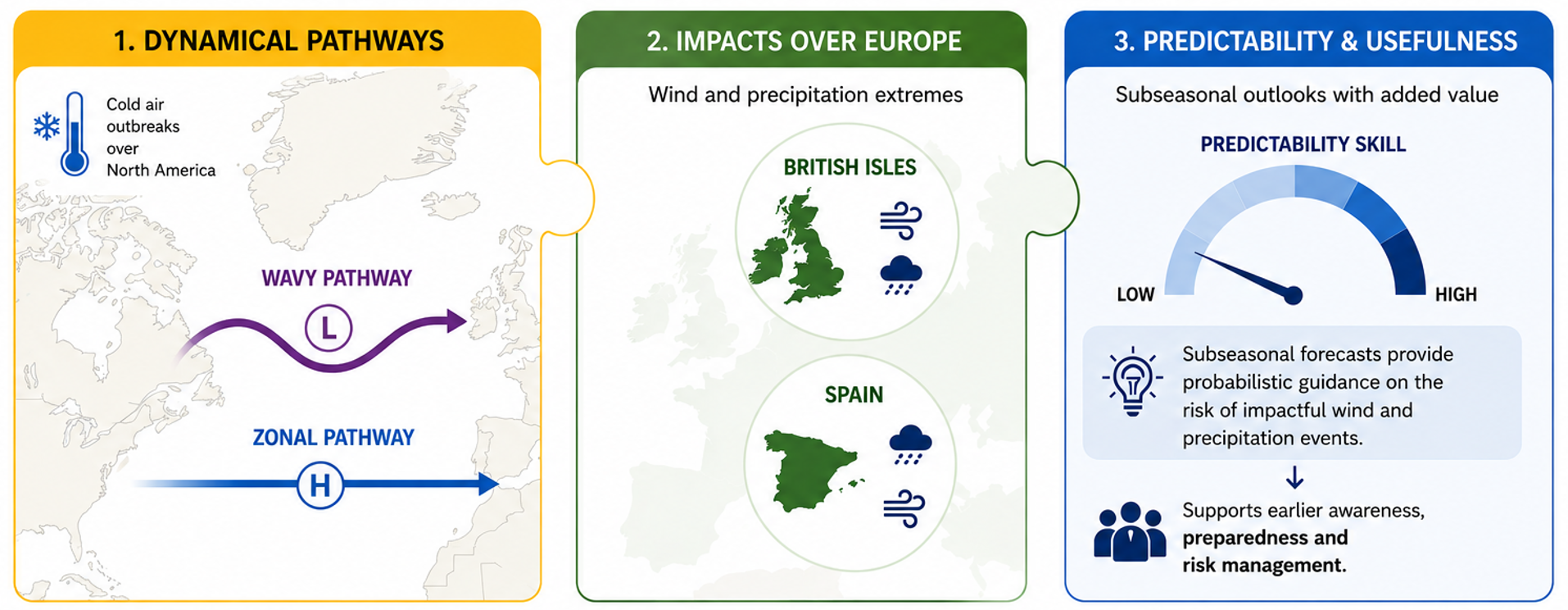 Figure 1 - Schematic illustrating the dynamical pathways behind pan-Atlantic compound extremes.
In our recent paper Krouma and Messori (2026), we investigate a type of compound event linking cold spells over eastern North America with wet and windy conditions over Western Europe. These pan-Atlantic extremes show how the atmosphere can connect distant regions through large-scale circulation patterns. A disruption on one side of the Atlantic may be part of a broader dynamical pathway leading to impacts elsewhere.
We focus on the dynamical drivers and predictability of these events. Compound extremes are often difficult to anticipate because they emerge from interactions between atmospheric waves, circulation regimes, persistence, and sometimes stratospheric conditions. By combining dynamical-systems indicators with ensemble reforecasts, we assess whether the atmospheric states leading to these events are intrinsically more or less predictable.
Our results show that different dynamical pathways have different levels of predictability. The zonal pathway appears more persistent and potentially more predictable than the wavy pathway, although both remain challenging compared with average winter conditions. This highlights an important message: not all extremes are equally predictable, and understanding their dynamics can help identify windows of opportunity for earlier warnings.
Figure 1 - Schematic illustrating the dynamical pathways behind pan-Atlantic compound extremes.
In our recent paper Krouma and Messori (2026), we investigate a type of compound event linking cold spells over eastern North America with wet and windy conditions over Western Europe. These pan-Atlantic extremes show how the atmosphere can connect distant regions through large-scale circulation patterns. A disruption on one side of the Atlantic may be part of a broader dynamical pathway leading to impacts elsewhere.
We focus on the dynamical drivers and predictability of these events. Compound extremes are often difficult to anticipate because they emerge from interactions between atmospheric waves, circulation regimes, persistence, and sometimes stratospheric conditions. By combining dynamical-systems indicators with ensemble reforecasts, we assess whether the atmospheric states leading to these events are intrinsically more or less predictable.
Our results show that different dynamical pathways have different levels of predictability. The zonal pathway appears more persistent and potentially more predictable than the wavy pathway, although both remain challenging compared with average winter conditions. This highlights an important message: not all extremes are equally predictable, and understanding their dynamics can help identify windows of opportunity for earlier warnings.
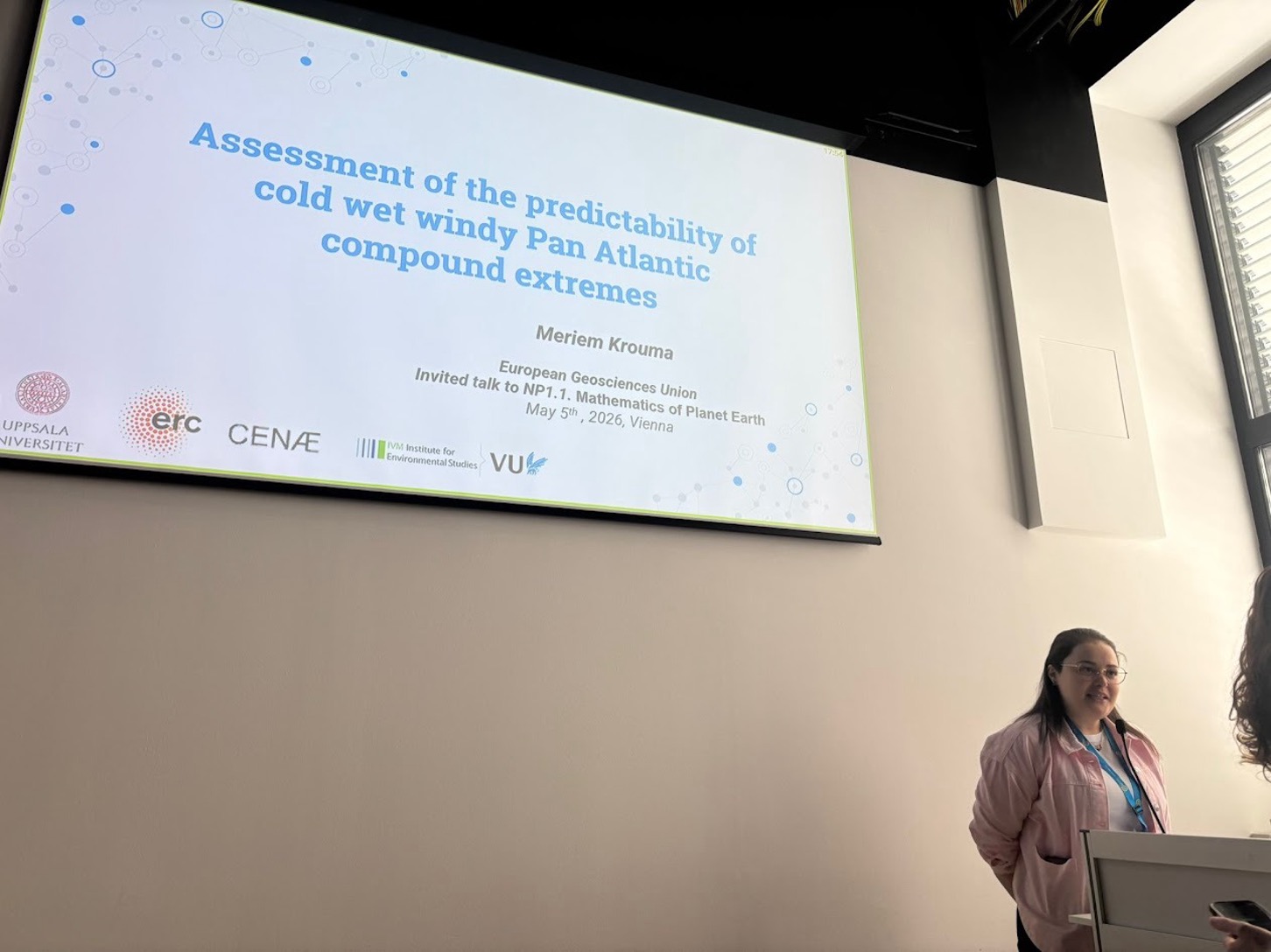 Figure 2 – Meriem presenting the paper Krouma and Messori (2026) at EGU26 as invited speaker by NP1.1.
Improved predictability of compound events can help us move from reacting to impacts after they occur towards anticipating when and where cascading risks may arise. This can support decisions in disaster preparedness, infrastructure management, energy planning, agriculture, and public health.
References
Krouma, M., & Messori, G. (2026). Predictability assessment of cold–wet–windy pan-Atlantic extremes. Weather and Climate Extremes, 52, 100903. https://doi.org/https://doi.org/10.1016/j.wace.2026.100903
Figure 2 – Meriem presenting the paper Krouma and Messori (2026) at EGU26 as invited speaker by NP1.1.
Improved predictability of compound events can help us move from reacting to impacts after they occur towards anticipating when and where cascading risks may arise. This can support decisions in disaster preparedness, infrastructure management, energy planning, agriculture, and public health.
References
Krouma, M., & Messori, G. (2026). Predictability assessment of cold–wet–windy pan-Atlantic extremes. Weather and Climate Extremes, 52, 100903. https://doi.org/https://doi.org/10.1016/j.wace.2026.100903 ⛈️?️ Early Career Researcher of the Month, November 2025 - Dr. Katharina Küpfer
Published: 2025-12-06 15:51:19Last update: 2025-12-06 15:51:19
By Lou Brett, University of Strathclyde
?We want to hear from you and your exciting research! Always wanted to make your research more visible? If you’re interested in joining the CompoundNET early career network, or even featuring as an EC of the month, this is your chance to ?️ fill out the form below:
Our Early Career Researcher (ECR) of the Month for November 2025 is Dr. Katharina Küpfer!
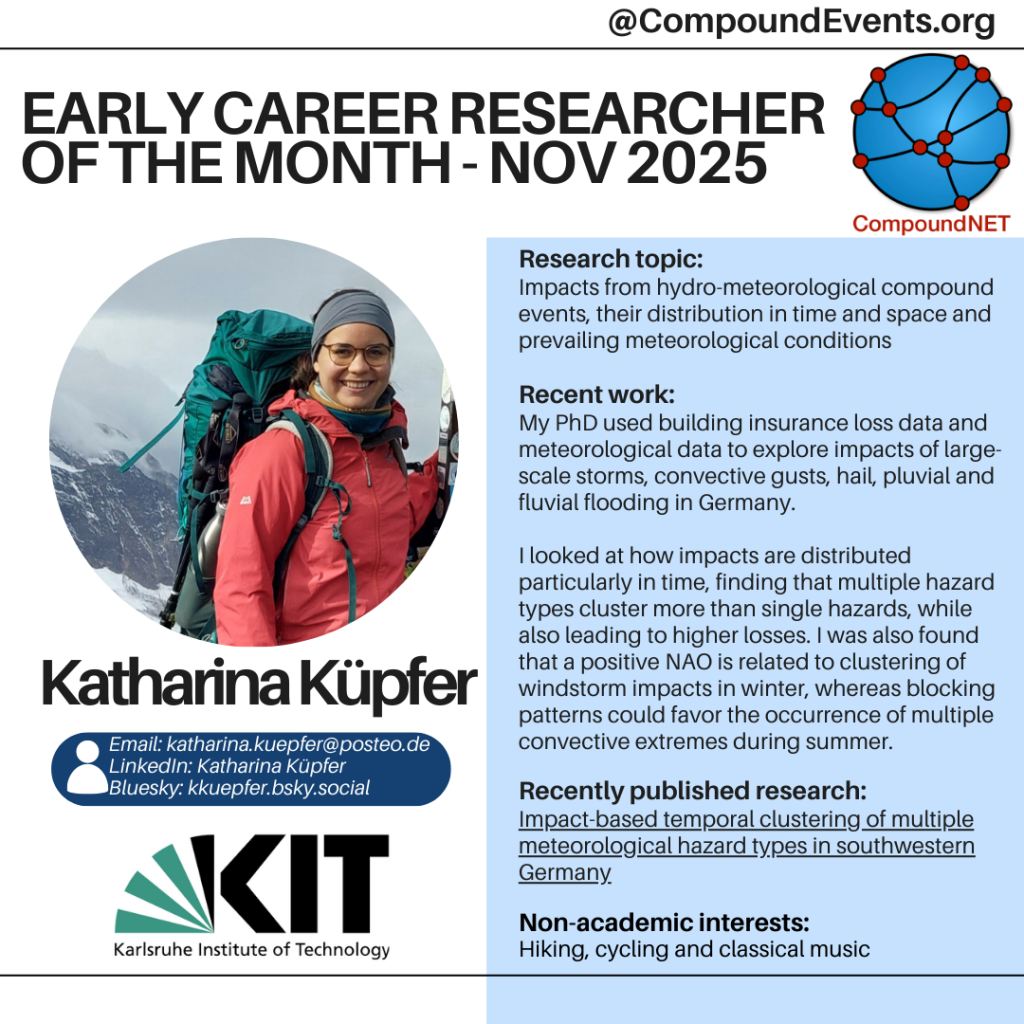
Katharina has recently finished her PhD at the Institute of Meteorology and Climate Research - Troposphere Research (IMKTRO), Karlsruhe Institute of Technology (KIT). ?
Katharina’s PhD combined building insurance loss data with meteorological data and investigated impacts of multiple hydro-meteorological extreme events (large-scale storms, convective gusts, hail, pluvial and fluvial flooding) and their interrelationships in Germany. She looked at how impacts are distributed particularly in time, finding that multiple hazard types cluster more than single hazards, while also leading to higher losses. She was also interested in potential atmospheric drivers and found that a positive NAO is related to clustering of windstorm impacts in winter, whereas blocking patterns could favor the occurrence of multiple convective extremes during summer.
Beyond her research interests, Katharina enjoys a range of hobbies including hiking, cycling and classical music! ?️? ?
If you are interested in reading more about Katharina’s research, please find her recent article below:
Impact-based temporal clustering of multiple meteorological hazard types in southwestern Germany (2025)
https://nhess.copernicus.org/articles/25/2885/2025/
Thanks for reading!
CompoundNET Team.
? Early Career Researcher of the Month, October 2025 - Dr. Yiwei Jian
Published: 2025-10-31 18:25:17Last update: 2025-10-31 18:34:18
By Lou Brett, University of Strathclyde
? We want to hear from you and your exciting research! Always wanted to make your research more visible? If you’re interested in joining the CompoundNET early career network, or even featuring as an ECR of the month, this is your chance to ?️ fill out the form HERE
Our Early Career Researcher (ECR) of the Month for October 2025 is Dr. Yiwei Jian!
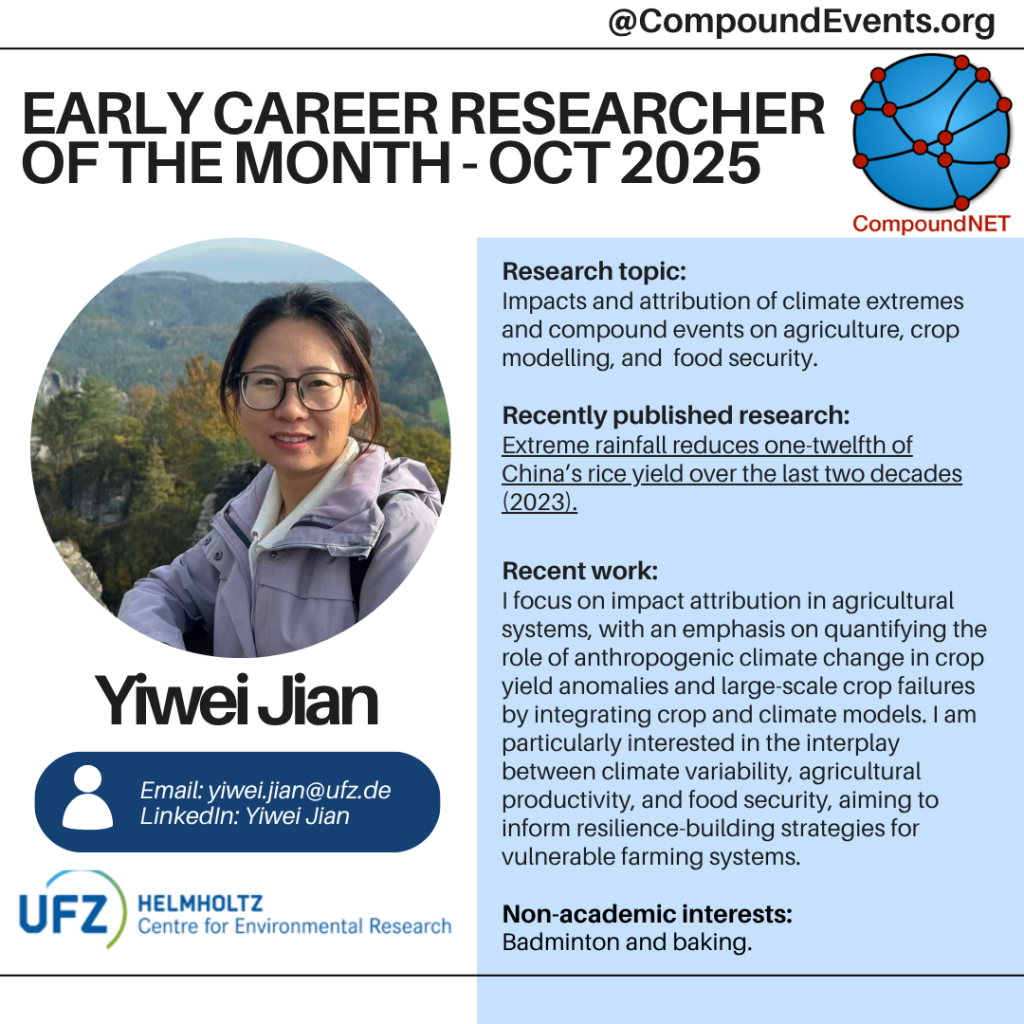
Yiwei is a postdoctoral researcher, at Helmholtz Centre for Environmental Research - UFZ, Germany. Yiwei’s recent research has been focusing on impact attribution in agricultural systems, with an emphasis on quantifying the role of anthropogenic climate change in crop yield anomalies and large-scale crop failures by integrating crop and climate models. Yiwei is particularly interested in the interplay between climate variability, agricultural productivity, and food security, aiming to inform resilience-building strategies for vulnerable farming systems.
Beyond her research interests, Yiwei enjoys playing badminton and baking tasty treats!
If you are interested in reading more about Yiwei’s research, please find their recent article below:
Extreme rainfall reduces one-twelfth of China’s rice yield over the last two decades, Nature Food (2023) https://doi.org/10.1038/s43016-023-00753-6
Thanks for reading!
CompoundNET Team.
Compounding, cascading, and critical risks to U.S. infrastructure and security: A systems-focused compound-hazard workshop
Published: 2025-09-17 08:12:13Last update: 2026-06-24 13:58:46
By Colin Raymond — University of California, Los Angeles
Organizing committee: Colin Raymond, Deepti Singh, Amir AghaKouchak, Oronde Drakes, Jennifer Helgeson, Kelly Hereid, Miyuki Hino, Paul Loikith, Francisco Peña Guerra, Alex Ruane, Antonia Sebastian
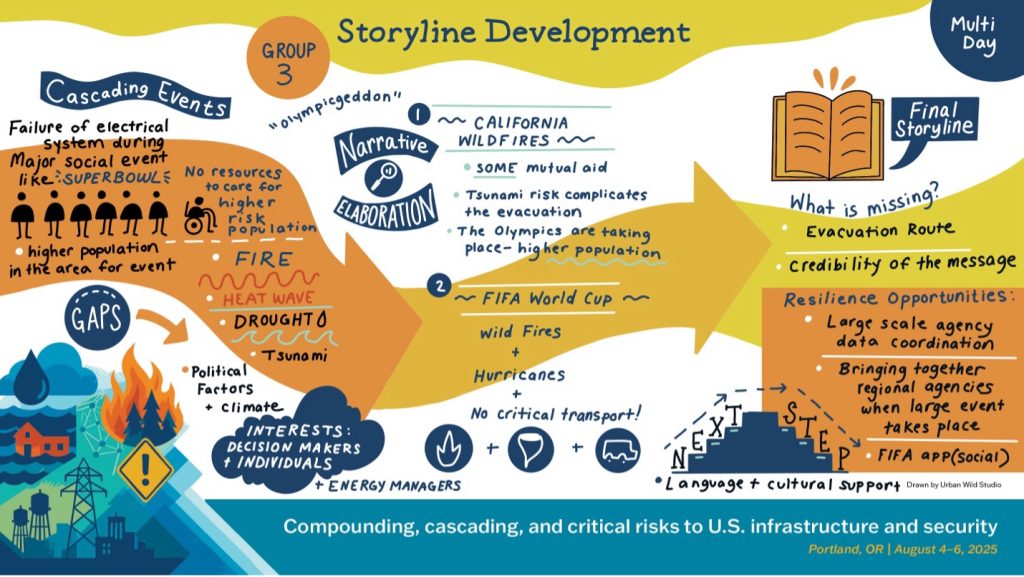
This ~80-person workshop took place in Portland, OR in early Aug 2025 and centered on small groups developing storylines to creatively reveal gaps in knowledge and practice around compound hazards. The format intermingled a few sessions of talks and panels with semi-structured small-group discussions and substantial breaks; midway in formality between the latter two was a first-day “speed dating” session that proved especially popular.
Attendance was drawn approximately half from the physical sciences and half from social sciences, policy/governance, NGOs, and climate-related industries. Conversations ranged over a wide array of topics, emphasizing both the complexity of compound hazards but also the potential for existing tools and capabilities to be more effectively applied through communication among professionals as well as with the public (for example, when encouraging general preparedness or announcing emergency evacuations).
A particular focal point concerned recent compound hazards in the US, such as the Sep 2024 Appalachian flooding from Hurricane Helene and Jan 2025 Los Angeles wildfires, that dramatically upended local risk assumptions and overwhelmed affected communities. Indeed, that certain compound hazards (such as earthquakes and related hazards in the Western US) inspire conscious and concerted planning efforts while others (such as wildfires in the eastern US) are mere afterthoughts, and that these disparities do not always correlate well with objective risk calculations, especially under climate change, was a recurring motif. Another important realization surrounded the existence of points of failure, such as the power grid, whose criticality in supporting multiple levels of preparedness, resilience, and recovery across health, economic, and other impacts seems to not be reflected in commensurate maintenance investments.
Despite recruitment efforts, much local and regional knowledge that could have contributed to the discussions was absent, a frequent situation but a major hurdle in developing truly actionable science. Nonetheless, the interdisciplinarity and focus on narratives both supported a certain fundamental unexpectedness of interaction that helped sustain engagement over the full three days.
The above themes were developed to a significant degree through the storyline exercises, and were summarized through notes (to serve as the basis of a fuller write-up) as well as graphic recordings, illustrated in the below figure. The workshop website will remain up to showcase further outcomes as they develop.
Genuine appreciation is extended to NSF for remaining committed to sponsoring this gathering.
? Early Career Researcher of the Month, August 2025 - Patrícia S. Silva
Published: 2025-08-26 13:28:16Last update: 2025-08-26 13:28:16
Patrícia S. Silva Yale School of the Environment
Patrícia recently completed her PhD, where her research focused on the dynamic interactions between fire, climate, vegetation, and human activities in tropical ecosystems. Using a combination of remote sensing products and climate reanalyses/models, she examined how extreme wildfires emerge and evolve - particularly in Brazilian biomes like the Amazon rainforest.
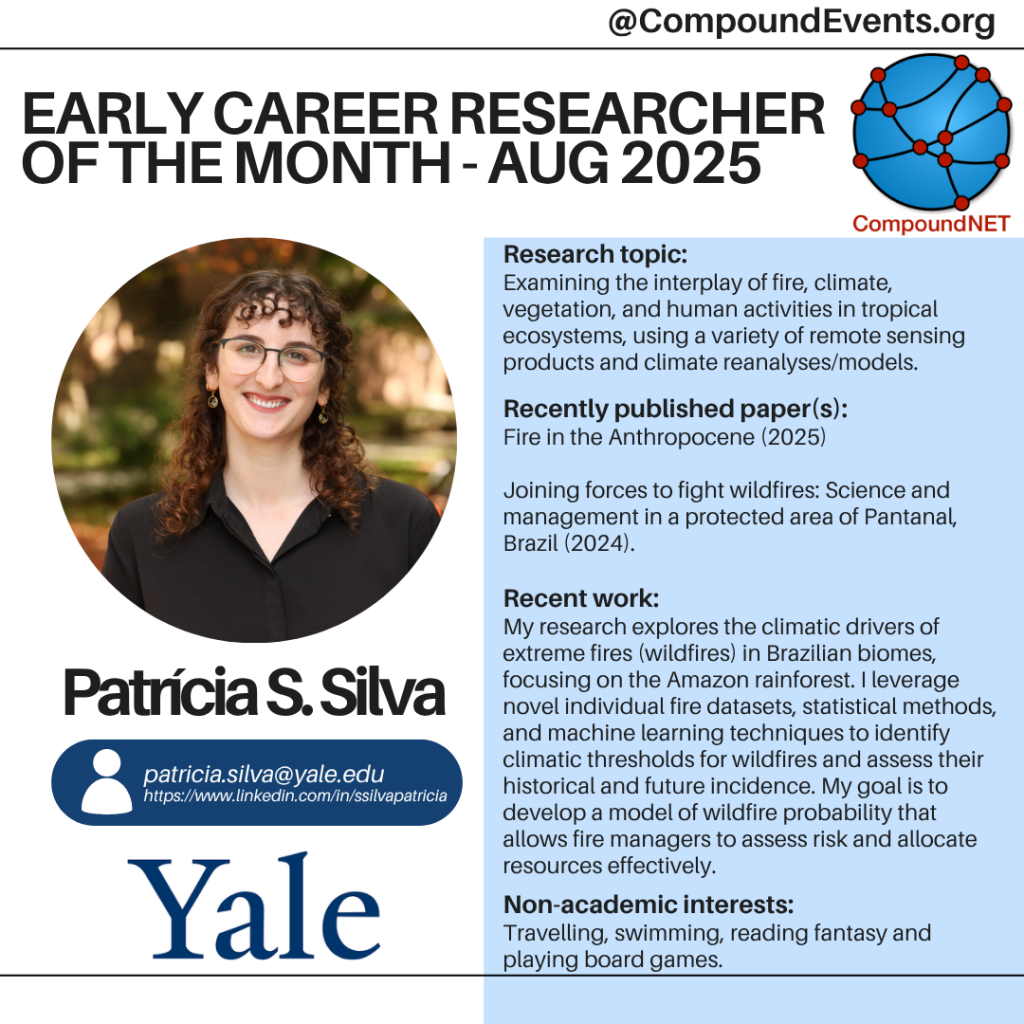
Her current work identifies climatic thresholds for wildfires using novel fire datasets, statistical techniques, and machine learning. The ultimate goal is to build a wildfire probability model that helps fire managers assess risk and allocate resources more effectively.
Outside of research, Patrícia enjoys travelling, swimming, reading fantasy novels, and playing board games.
If you are interested in reading more about Patrícia’s research, please find her recent articles below:
- "Fire in the Anthropocene (2025)
https://link.springer.com/chapter/10.1007/978-3-031-89372-8_13 - "Joining forces to fight wildfires: Science and management in a protected area of Pantanal, Brazil"
https://doi.org/10.1016/j.envsci.2024.103818
Thanks for reading!
By Lou Brett, University of Strathclyde, on behalf of CompoundNET.
? Got exciting research to share? We’d love to hear from you! If you're looking to boost the visibility of your work and connect with others in the field, why not join the CompoundNET Early Career Network? You could even be featured as our Early Career Researcher of the Month! ?️
Interested? Just fill out the form below: ?
Early Career Researcher (ECR) of the Month (July 2025) – Lou Brett
Published: 2025-07-27 17:18:58Last update: 2025-07-27 17:28:28
By Lou Brett, University of Strathclyde
? Got exciting research to share? We’d love to hear from you! If you’re looking to boost the visibility of your work and connect with others in the field, why not join the CompoundNET Early Career Network? You could even be featured as our Early Career Researcher of the Month! ?️ Interested? Just fill out the form HERE
Our Early Career Researcher (ECR) of the Month for July 2025 is Lou Brett!
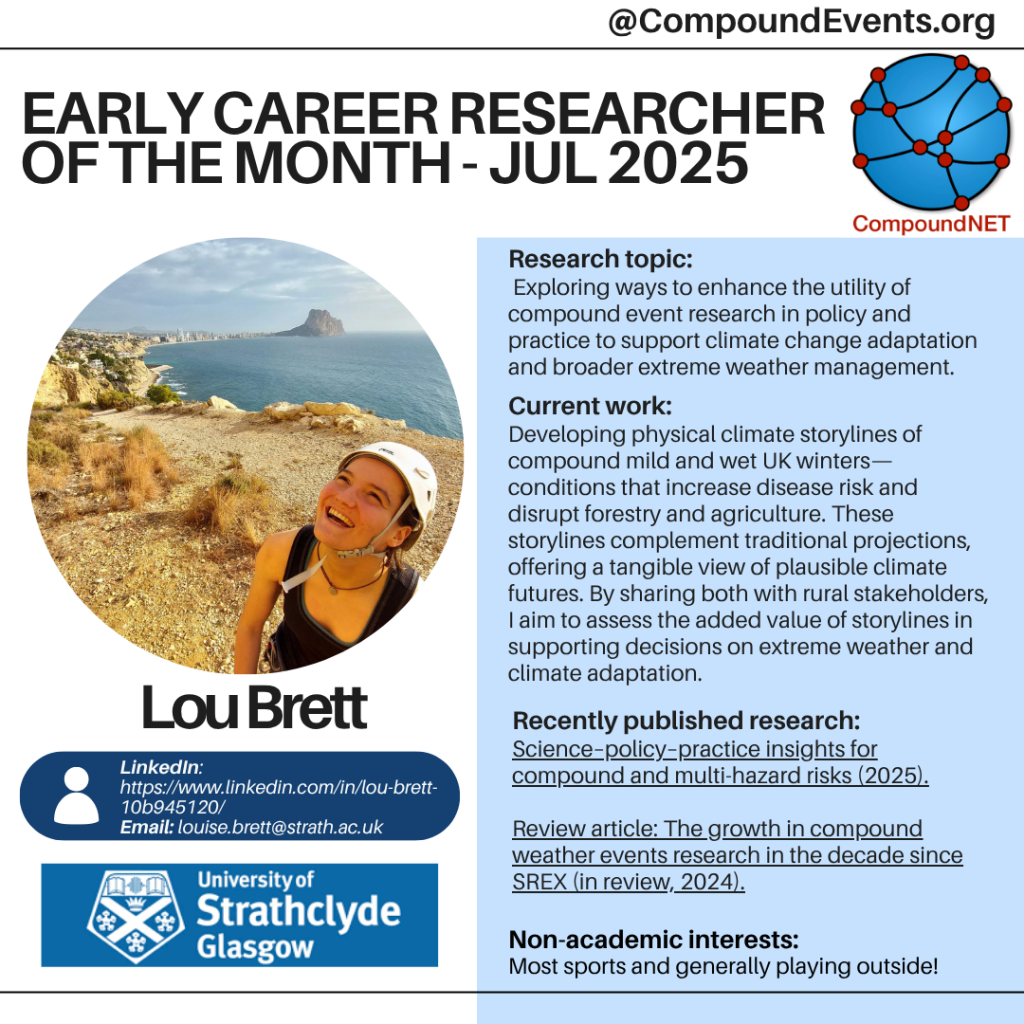
Lou Brett is currently in the 4th year of her PhD at University of Strathclyde, Glasgow. Lou’s research focuses on exploring ways to enhance the utility of compound event research in policy and practice to support climate change adaptation and broader extreme weather management.
Lou’s recent work includes a review of compound events research (2012–2022), a workshop paper on multi-hazard approaches to managing such events, and surveys and interviews in rural Scotland exploring how these events are experienced and what’s needed to build resilience.
Lou’s is now developing physical climate storylines of compound mild and wet UK winters—conditions that increase disease risk and disrupt forestry and agriculture. These storylines complement traditional projections, offering a tangible view of plausible climate futures. By sharing both with rural stakeholders, Lou aims to assess the added value of storylines in supporting decisions on extreme weather and climate adaptation.
Beyond her research interests, Lou enjoys a wide range of sports and generally playing outside!
If you are interested in reading more about Lou’s research, please find her recent articles below:
Science–policy–practice insights for compound and multi-hazard risks (2025) https://doi.org/10.1002/met.70043
Review article: The growth in compound weather events research in the decade since SREX (in review, 2024) https://doi.org/10.5194/nhess-2024-182
Thanks for reading!
CompoundNET
Early Career Researcher (ECR) of the Month (June 2025) – Ling Yang
Published: 2025-06-29 11:50:48Last update: 2025-06-29 12:15:59
By Lou Brett, University of Strathclyde
? Got exciting research to share? We’d love to hear from you! If you’re looking to boost the visibility of your work and connect with others in the field, why not join the CompoundNET Early Career Network? You could even be featured as our Early Career Researcher of the Month! ?️ Interested? Just fill out the form below:
We’re excited to spotlight Ling Yang, our Early Career Researcher (ECR) of the Month for June 2025!
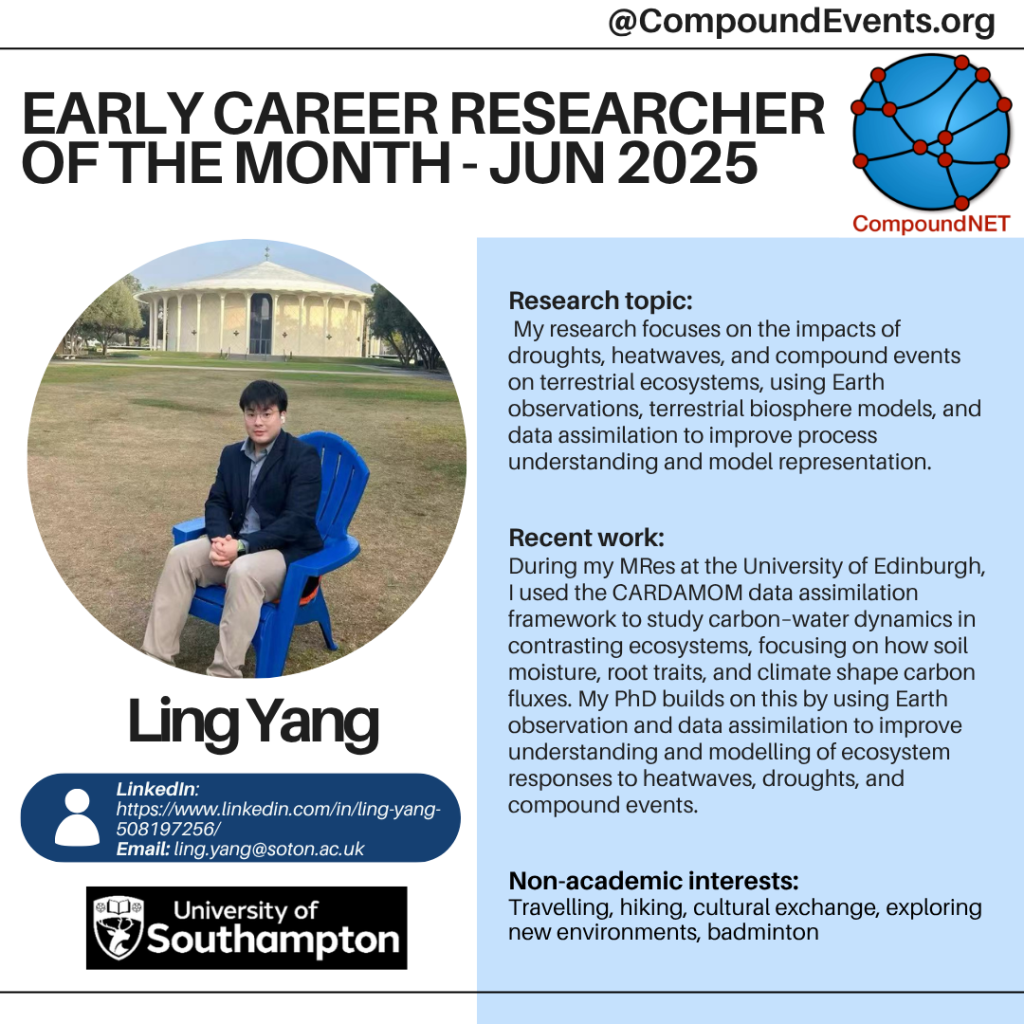
Ling is in the first year of their PhD at the University of Southampton, where they are investigating how droughts, heatwaves, and compound events affect terrestrial ecosystems.
Their research combines Earth observations, terrestrial biosphere models, and data assimilation techniques to improve both process understanding and model representation of how ecosystems respond to climate extremes.
Before starting their PhD, Ling completed an MRes at the University of Edinburgh, where they used the CARDAMOM data assimilation framework to constrain biosphere models and explore carbon–water dynamics in contrasting ecosystems like Howard Springs (Australia) and Las Majadas (Spain). This work highlighted how soil moisture, root traits, and climate regimes jointly shape ecosystem carbon responses.
Ling’s PhD continues in this direction, now focusing more on how ecosystems respond to compound climate hazards—such as co-occurring droughts and heatwaves—using state-of-the-art modelling approaches.
Outside of academia, Ling enjoys travelling, hiking, exploring new environments, and playing badminton. They are also passionate about cultural exchange and building community through shared outdoor experiences.
? Connect with Ling on LinkedIn
Thanks for reading!
CompoundNET.
Early Career Researcher (ECR) of the Month (May 2025) - Javed Ali
Published: 2025-05-25 10:02:37Last update: 2025-05-25 10:02:37
By Lou Brett, University of Strathclyde
? Got exciting research to share? We’d love to hear from you! If you’re looking to boost the visibility of your work and connect with others in the field, why not join the CompoundNET Early Career Network? You could even be featured as our Early Career Researcher of the Month! ?️ Interested? Just fill out the form below:
https://docs.google.com/forms/d/e//viewform?usp=sf_link
Our Early Career Researcher (ECR) of the Month for May 2025 is Javed Ali!
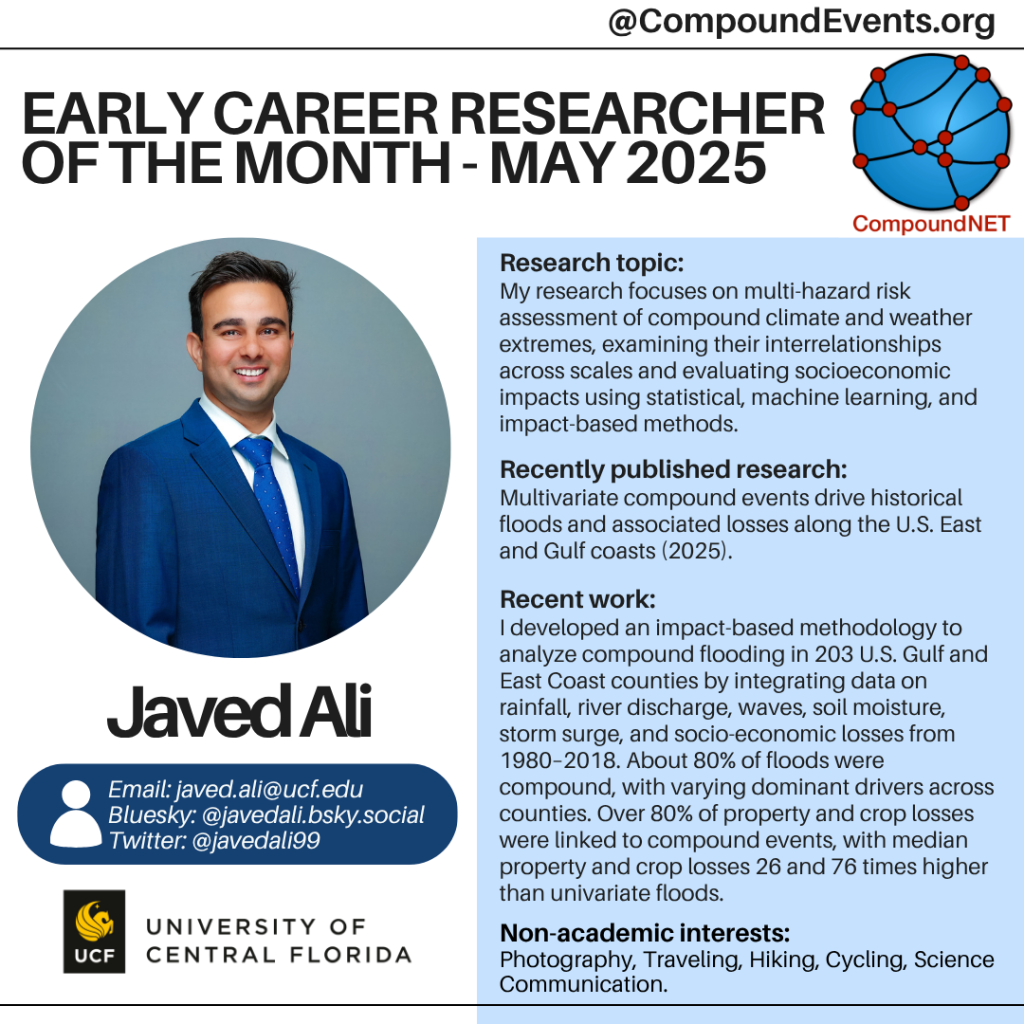
Javed Ali is currently in the 4th year of his PhD at University of Florida, USA. Javed’s research focuses on multi-hazard risk assessment and analyzing compound climate and weather extreme events to understand their complex interrelationships across various spatial and temporal scales and assess their socioeconomic impacts using statistical, machine learning and impact-based methodologies.
Some of Javed’s recent research has included developing an impact-based methodology to analyze compound flooding in 203 coastal counties along the U.S. Gulf and East coasts by integrating data from multiple flood drivers—rainfall, river discharge, waves, soil moisture, and storm surge—with socio-economic loss records from 1980 to 2018. Approximately 80% of flood events were compound, driven by more than two flood drivers. Spatial clustering revealed variability in dominant drivers across counties. In over 80% of counties, more than 80% of property and crop losses were linked to compound events, with median property losses 26 times and crop losses 76 times greater than those from univariate flooding.
Beyond his research interests, Javed enjoys a wide range of activities including photography, travelling, hiking, cycling and science communication!
If you are interested in reading more about Javed’s research, please find his recent article below:
Multivariate compound events drive historical floods and associated losses along the U.S. East and Gulf coasts (2025) https://doi.org/10.1038/s44304-025-00076-5
Thanks for reading!
CompoundNET.
Early Career Researcher (ECR) of the Month (April 2025) - Bianca Biess
Published: 2025-04-28 07:41:15Last update: 2025-04-28 07:50:08
By Lou Brett, University of Strathclyde
?We want to hear from you and your exciting research! Always wanted to make your research more visible? If you’re interested in joining the CompoundNET early career network, or even featuring as an EC of the month, this is your chance to ?️ fill out this form.
Our Early Career Researcher (ECR) of the Month for April 2025 is Bianca Biess!
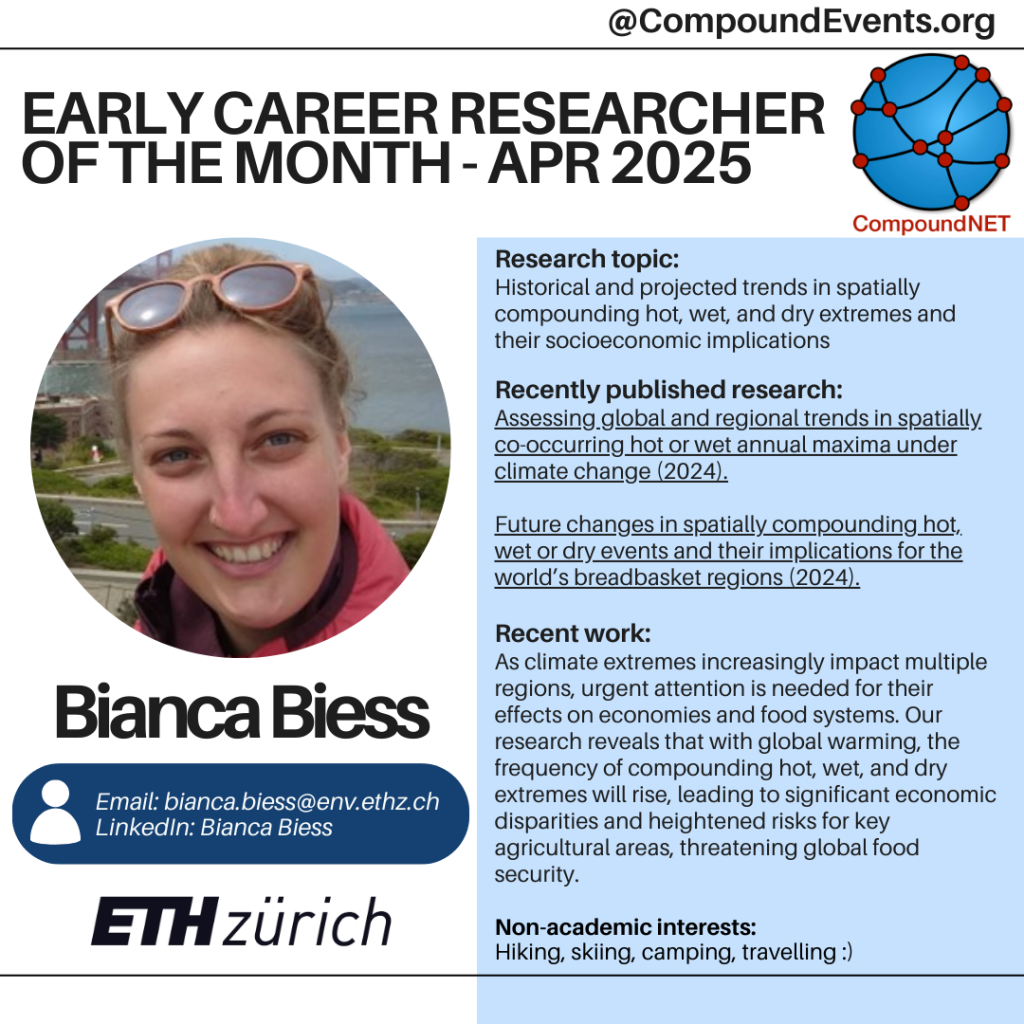
Bianca recently earned her PhD, and is now a postdoctoral researcher, at ETH Zurich, Switzerland. Bianca’s recent research has been examining how spatially compounding hot, wet, and dry extremes will intensify with global warming and their socioeconomic consequences. Using CMIP6 simulations, her findings show a sharp rise in affected global GDP, with economic interconnectedness amplifying regional disparities. Additionally, critical agricultural regions face escalating risks, threatening global food security. Together, these findings highlight the need to examine the impacts of climate change not only at local and regional scales but also in the context of cross-regional and planetary-scale dependencies. This is because when multiple regions experience simultaneous climate-related disruptions, cascading effects can amplify climate-induced impacts across borders and scales. Consequently, it is important to understand these interconnected dynamics to inform strategies to mitigate and adapt to the growing challenges of spatially compounding climate extremes.
Beyond her research interests, Bianca enjoys hiking, skiing, camping, and traveling, making Zurich an excellent city for both her academic and personal pursuits!
If you are interested in reading more about Bianca’s research, please find her recent articles below:
Assessing global and regional trends in spatially co-occurring hot or wet annual maxima under climate change (2024) https://doi.org/10.1029/2023EF004114
Future changes in spatially compounding hot, wet or dry events and their implications for the world’s breadbasket regions (2024) https://iopscience.iop.org/article/10.1088/1748-9326/ad4619
Thanks for reading!
CompoundNET.
Recent reads by Sha Zhou
Published: 2025-04-08 09:21:16Last update: 2025-04-08 14:28:38
In the new "Recent Reads" series, prominent researchers describe a selection of papers from the last few years that have made an impact on their thinking about the direction of compound-events research or its implications. Shorter than a blog post, longer than a tweet, we hope these annotations provide a helpful glimpse into the work that others have been reflecting upon! - Colin Raymond

About me - I am Sha Zhou, a research scientist at the Faculty of Geographical Science, Beijing Normal University (BNU). I received my Bachelor's and PhD degrees from the Department of Hydraulic Engineering at Tsinghua University and worked as a postdoctoral researcher and associate research scientist at Columbia University before joining BNU in 2021. My research focuses on land-atmosphere interactions and hydroclimate changes, with an emphasis on climate extremes and their impacts on terrestrial ecosystems. By advancing our understanding of past and future climate system changes and their impacts on hydrological and ecological processes, my work aims to improve predictive capabilities and develop effective strategies to mitigate the adverse effects of climate change.
Recent reading notes on heat waves
This paper introduces a novel Lagrangian approach to quantify the contributions of advection, adiabatic warming, and diabatic heating to atmospheric hot extremes globally. The authors systematically decompose temperature anomalies during the hottest days of the year (TXIday events) and reveal strong geographical variations in the dominant processes. For instance, advection dominates over mid-latitude oceans, adiabatic warming near mountain ranges, and diabatic heating over tropical and subtropical land masses. The study also highlights that hot extremes often form over several days and large spatial scales, emphasizing the non-local nature of these events.
In my view, this work resolves a long-standing debate about the relative importance of different physical processes in forming hot extremes. By providing a global, quantitative breakdown, it offers a new framework for evaluating climate models and understanding how hot extremes may change in a warming climate. The findings are particularly important for improving climate projections and developing adaptation strategies, as they reveal that hot extremes are not just local phenomena but result from complex, large-scale atmospheric processes. The study also connects atmospheric dynamics with surface processes, offering a more integrated view of heat wave formation.
This paper investigates the spatiotemporal evolution of large contiguous heatwaves, focusing on their propagation patterns, including moving distance, speed, and direction. The authors identify significant changes in heatwave behavior from 1979 to 2020, with heatwaves becoming longer-lasting, traveling greater distances, and moving more slowly. These changes have been amplified since 1997, likely due to weakening eddy kinetic energy, zonal winds, and anthropogenic forcing. The study also highlights that these trends are more pronounced in the Northern Hemisphere, particularly in regions like Eurasia and North America, where heatwaves are linked to atmospheric blocking and land-atmosphere feedbacks.
This work provides a comprehensive understanding of how heatwaves evolve in both space and time, addressing a gap in previous studies that primarily focused on fixed locations or durations. By introducing new metrics to track heatwave propagation, I feel that the study offers valuable insights into the mechanisms driving these changes, particularly the role of anthropogenic forcing. The findings are crucial for improving early warning systems and adaptation strategies, as slower-moving and longer-lasting heatwaves can have more severe impacts on human health, ecosystems, and economies. The study also connects atmospheric dynamics with climate change, suggesting that future heatwaves will be even more devastating if greenhouse gas emissions continue to rise. For me, this research underscores the need for immediate mitigation efforts to reduce the risks posed by these extreme events.
This paper investigates the role of anthropogenic climate change in altering the occurrence probabilities of marine heatwaves (MHWs). The authors show that the likelihood of large, impactful MHWs has increased more than 20-fold due to human-induced global warming. MHWs that were once rare events in the preindustrial era (occurring once every hundreds to thousands of years) are projected to become decadal to centennial events under 1.5°C warming and annual to decadal events under 3°C warming. The study focuses on seven major MHWs with documented ecological impacts, such as the Northeast Pacific 2013–2015 MHW and the Northwest Atlantic 2012 MHW, and quantifies their attributable risk to climate change using a consistent attribution framework.
This work provides a robust and systematic approach to attributing MHWs to anthropogenic climate change, addressing a significant gap in the literature. By quantifying the fraction of attributable risk (FAR) for MHW duration, intensity, and cumulative intensity, the study demonstrates that human activities have already substantially increased the likelihood of these extreme events. The findings are critical for understanding the risks posed by MHWs to marine ecosystems, which are highly sensitive to temperature changes. The study also highlights the urgent need for ambitious climate targets to mitigate future impacts, as even moderate warming (1.5°C to 3°C) will drastically reduce the return periods of MHWs, pushing marine ecosystems beyond their thermal limits. Ultimately, I think this research underscores the interconnectedness of climate change and marine biodiversity, offering a compelling case for immediate global action to limit warming and protect oceanic ecosystems.
This paper investigates the future shifts in compound drought and heatwave (CDHW) events under different climate change scenarios. The authors project significant increases in the frequency, duration, and severity of CDHW events across various regions, particularly in East Africa, North Australia, East North America, Central Asia, Central Europe, and Southeastern South America. The study highlights that the Southern Hemisphere will experience a greater increase in CDHW frequency, while the Northern Hemisphere will see a greater increase in severity. The authors also identify that regional warming plays a significant role in driving these changes, with disproportionate warming in certain areas exacerbating the risk of CDHW events.
This study provides a comprehensive analysis of how climate change will amplify the risk of CDHW events, which are known to have severe impacts on agriculture, water resources, ecosystems, and human health. By using a multi-model ensemble approach and considering different Shared Socioeconomic Pathways (SSPs), the authors offer a robust projection of future CDHW risks. I would say that the findings are particularly important for policymakers and stakeholders in vulnerable regions, as they underscore the need for adaptation and mitigation strategies to cope with the increasing frequency and severity of these compound extreme events. The study also highlights the importance of regional warming patterns, suggesting that localized climate policies may be necessary to address the disproportionate impacts of climate change in certain areas. This research bridges the gap between global climate projections and regional impacts, offering actionable insights for managing future climate risks.
Thanks for reading!
CompoundNET.
Early Career Researcher (ECR) of the Month (March 2025) - Faranak Tootoonchi
Published: 2025-04-02 15:32:20Last update: 2025-04-02 15:33:18
By Lou Brett, University of Strathclyde
?We want to hear from you and your exciting research! Always wanted to make your research more visible? If you’re interested in joining the CompoundNET early career network, or even featuring as an EC of the month, this is your chance to ?️ fill out this form.
Our Early Career Researcher (ECR) of the Month of March 2025 is Faranak Tootoonchi!
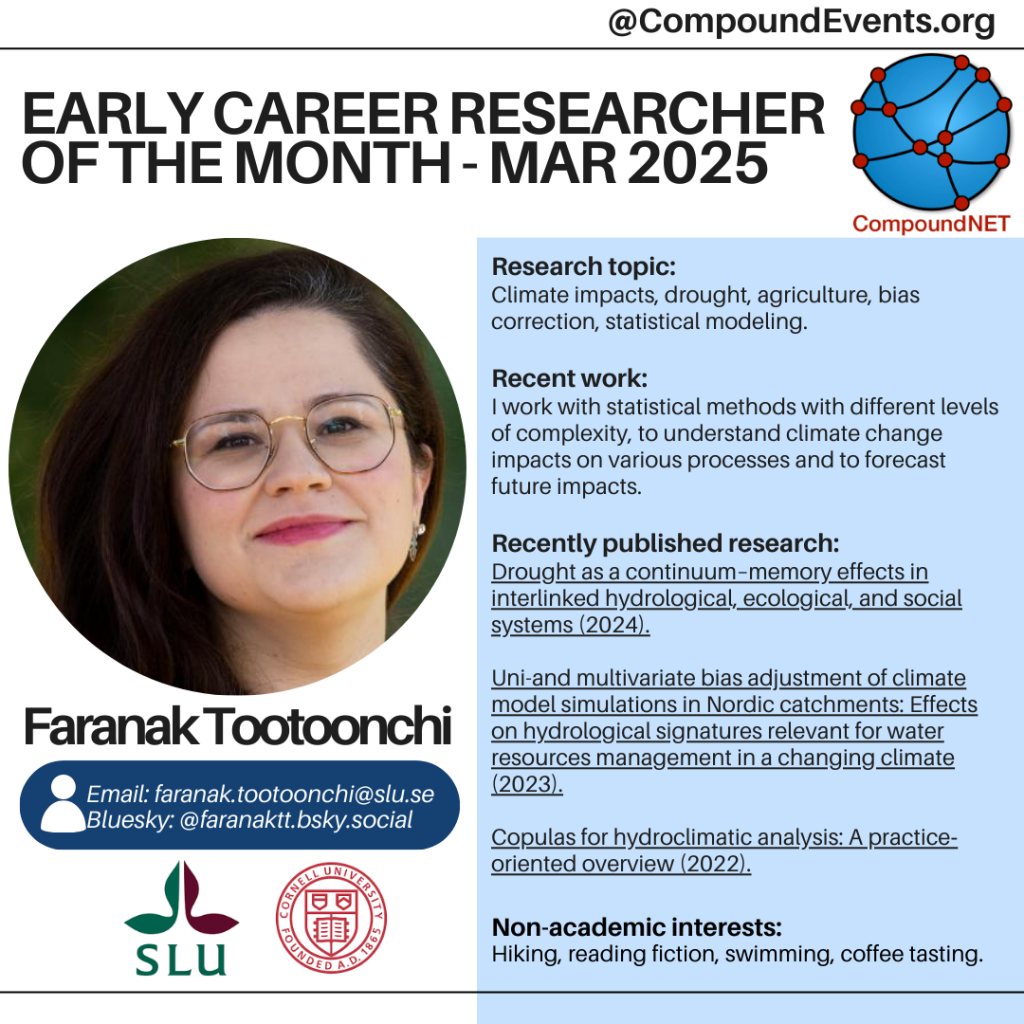
Faranak is a postdoctoral researcher based at the Swedish University of Agricultural Sciences (SLU), working with statistical methods of varying complexity to understand the impacts of climate change on various processes and to forecast future effects.
Faranak has published a number of papers. If you are interested in reading more about her research, please explore the papers below:
Drought as a continuum–memory effects in interlinked hydrological, ecological, and social systems (2024) https://doi.org/10.5194/egusphere-2024-421
Uni-and multivariate bias adjustment of climate model simulations in Nordic catchments: Effects on hydrological signatures relevant for water resources management in a changing climate (2023) https://doi.org/10.1016/j.jhydrol.2023.129807
Copulas for hydroclimatic analysis: A practice‐oriented overview (2022) https://doi.org/10.1002/wat2.1579
Beyond professional interests, Faranak enjoys hiking, reading fiction, swimming & coffee tasting!
Thanks for reading!
CompoundNET.
Early Career Researcher (ECR) of the Month (February 2025) - Jan Sodoge
Published: 2025-03-09 08:40:06Last update: 2025-04-02 15:31:50
By Lou Brett, University of Strathclyde
?We want to hear from you and your exciting research! Always wanted to make your research more visible? If you’re interested in joining the CompoundNET early career network, or even featuring as an EC of the month, this is your chance to ?️ fill out this form.
Our Early Career Researcher (ECR) of the Month of February 2025 is Jan Sodoge!
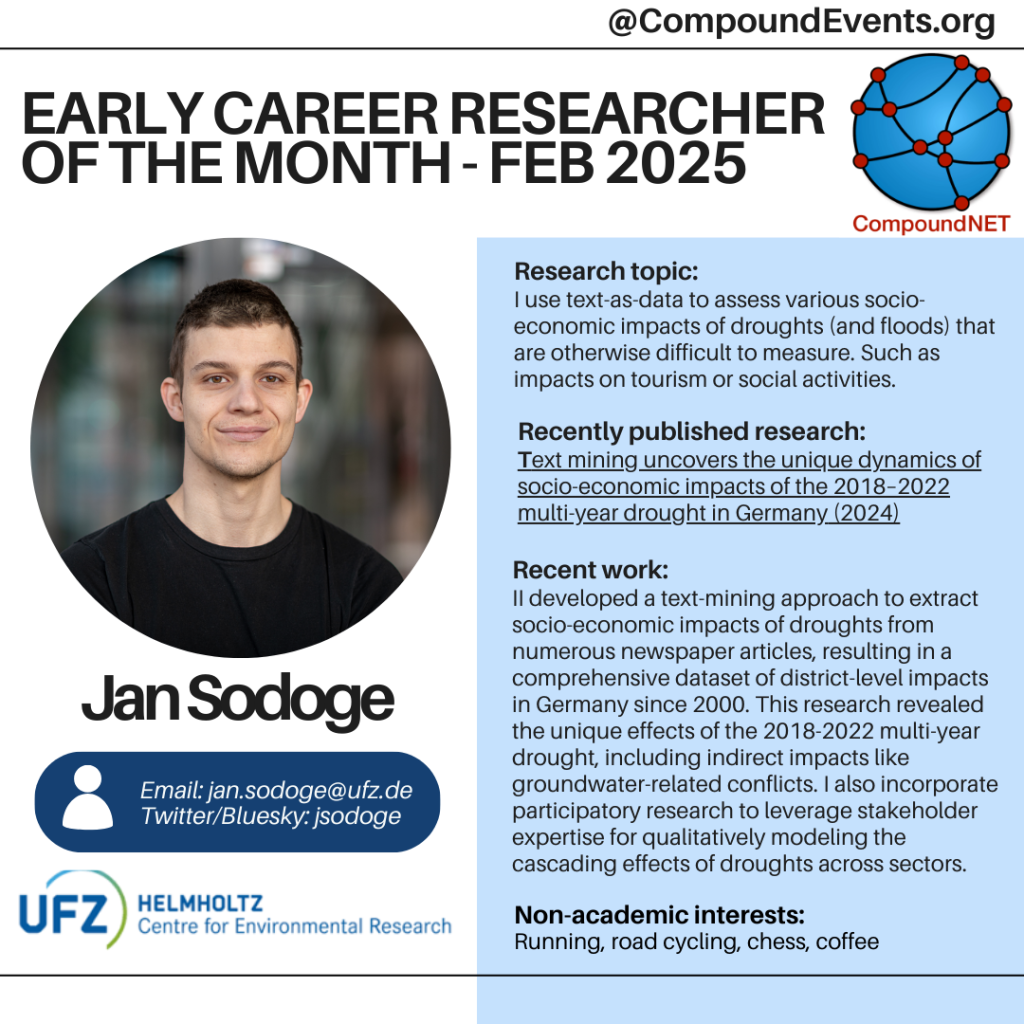
Jan is a trained computational social scientist that recently earned his PhD, and is now a postdoctoral researcher, at Helmholtz Centre for Environmental Research, Germany. During his PhD Jan developed a text-mining approach that extracts the socio-economic impacts of droughts from a large corpus of newspaper articles. Via this approach, he obtained a comprehensive dataset covering various impacts in Germany since 2000 on a district level. In consequent work, this helped Jan to understand how the recent multi-year drought in Germany from 2018-2022 was unique from an impacts perspective and how, for example, heat events affected impacts during this period.
Additionally, text-mining helps Jan to understand more indirect impacts, such as mapping groundwater-related conflicts. He complemented this work with participatory research that leveraged stakeholder expertise to qualitatively model the cascading impacts of droughts across sectors. In the future, Jan would like to link these two streams of research. Besides his work on impacts, Jan is also very curious about leveraging text-as-data and machine learning to foster interdisciplinary research by developing recommendation systems for academic conferences such as EGU.
Beyond professional interests, Jan enjoys running, road cycling, chess & coffee (an excellent range of activities)!
If you are interested in reading more about Jan’s research, please find his recent article below:
https://doi.org/10.5194/nhess-24-1757-2024
Thanks for reading!
CompoundNET.
AGU 2024 Session on Compound, Consecutive, and Cascading Events
Published: 2025-01-31 10:37:28Last update: 2025-02-04 17:26:23
By Helena Garcia, University of North Carolina at Chapel Hill
Conveners: Alejandra Enriquez, Helena Garcia, Mona Hemmati, Md Mamunur Rashid, Colin Raymond, Marleen de Ruiter, Cass Rogers, Antonia Sebastian
In Washington, DC on December 12-13, we convened a session titled “Compound, Consecutive, and Cascading Events: Challenges for Risk Assessment and Management” within the Natural Hazard section of the American Geophysical Union (AGU) 2024 conference. Presentations and posters in this session focused on multi-hazards and their interrelationships, from triggering to compounding, as well as resulting impacts across different sectors. The need to shift from single to multi-hazard risk assessment was a key motivator for convening this session, especially as instances of multi-hazards are expected to become more frequent and intense.
Poster Session:
The poster session showcased 16 diverse studies, spanning different multi-hazard topics and scales from local to global. Many posters focused on compound flooding risks, including efforts to disentangle the different processes of compound flooding (e.g., storm surge, extreme precipitation) as well as methods for rapid identification of compound flooding using satellite imagery. A number of case-studies highlighted specific events, such as Typhoon Gaemi (2024) and flood-triggered landslides and debris flows in North Vietnam. Several posters examined the impacts of multi-hazard events—typically flooding combined with another hazard—on local businesses (via business interruptions), utilities (e.g., water purification plants in Japan, power outages in Florida, USA), and infrastructure (e.g., road network disruptions, bridge failures). Some posters explored hazard events over time, addressing topics like the temporal clustering of storm surge, event-based flood exposure mapping, and comparing methods for detecting single versus compound hazard events. Finally, a few posters focused specifically on compound dry and hot events, examining the uncertainty of future projections and techniques for characterizing historical occurrences. Overall, the poster session contained a wide mix of multi-hazard topics—from characterization to challenges—and the poster hall was busy with conversations, questions, and feedback!
Oral Session:
The oral session featured seven presenters, focusing on a range of multi-hazard topics, from post-fire floods to compound heat-tropical cyclone events. The session kicked off with our invited speaker, Dr. James Doss-Gollin from Rice University, who spoke about leveraging machine learning and artificial intelligence (ML/AI) in urban flood research and management. He emphasized the importance of embracing uncertainty in decision-making, noting that although ML/AI can improve flood models, they are not perfect solutions—uncertainty will remain a key challenge in multi-hazard management!
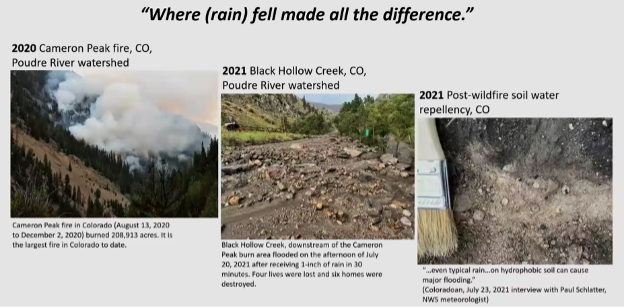
The next two talks focused on post-fire flood risks. The first talk showed the spatial distribution of post-fire flood risk in Riverside, California, and the second talk highlighted a method for improved runoff predictions following fires using a measure called sorptivity, which describes water repellency in soils. The following talk explored extreme value analysis (EVA) of tropical cyclones and extratropic cyclones, stressing the need to separate EVAs by storm types to avoid low-biased estimates. This presentation also included a case study in New York City, reporting that the most intense tropical cyclone rain and surge events have the most potential for compounding.
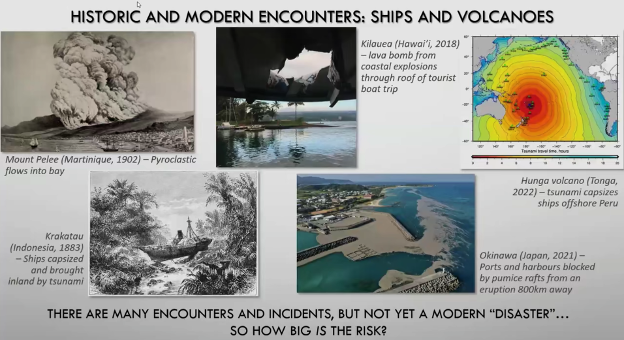
The next presenter shifted to focusing on global shipping vulnerabilities to marine and coastal volcanic hazards. This talk highlighted how volcano hazard maps rarely extend offshore, even though there are historical examples of pyroclastic flows and pumice blockages impacting ports, as well as eruption-triggered tsunamis capsizing vessels. The maps presented identified high-risk areas, such as the Mediterranean Sea and the Sea of Japan.
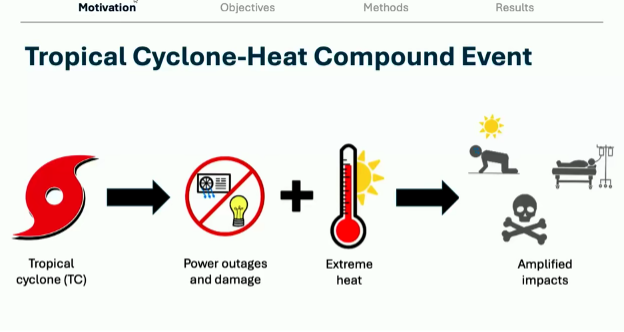
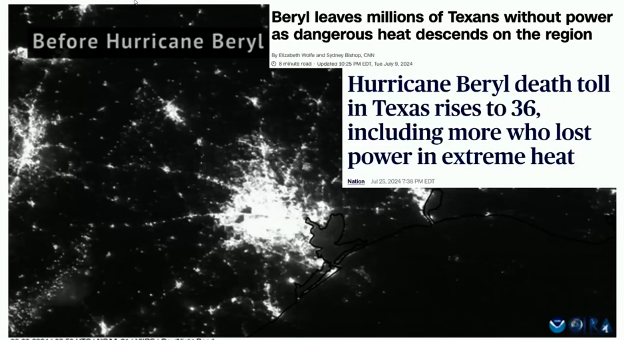
Our final two presenters examined compound events involving heat and tropical cyclones globally, as well as heat and extreme precipitation in the US southeast. In the US southeast, both heat-preceding-precipitation and heat-following-precipitation events were identified and trends showed that both these kinds of multi-hazards have increased 5-fold since 1940. From a global perspective, there are few observations of heat events following tropical cyclones, although there are recent notable examples like Hurricane Beryl (2024) in Houston, Texas. In this final presentation, global climate models (GCMs) were leveraged to see how well they capture tropical cyclone-heat hazards. When compared to historical observations (1980-2020), the models found fewer events but identified similar hotspots in Mexico, India, East Asian and northern Australia.
We had great questions from the audience throughout our oral session and were especially grateful to all who showed up and participated bright and early on Friday morning at AGU!
Post edited by Cassandra Rogers and Andreia Ribeiro.
Early Career Researcher (ECR) of the Month (January 2025) - Yinglin Tian
Published: 2025-01-29 14:17:46Last update: 2025-01-29 16:17:17
By Lou Brett, University of Strathclyde
?We want to hear from you and your exciting research! Always wanted to make your research more visible? If you’re interested in joining the CompoundNET early career network, or even featuring as an EC of the month, this is your chance to ?️ fill out this form.
Our Early Career Researcher (ECR) of the Month for January 2025 is Yinglin Tian!
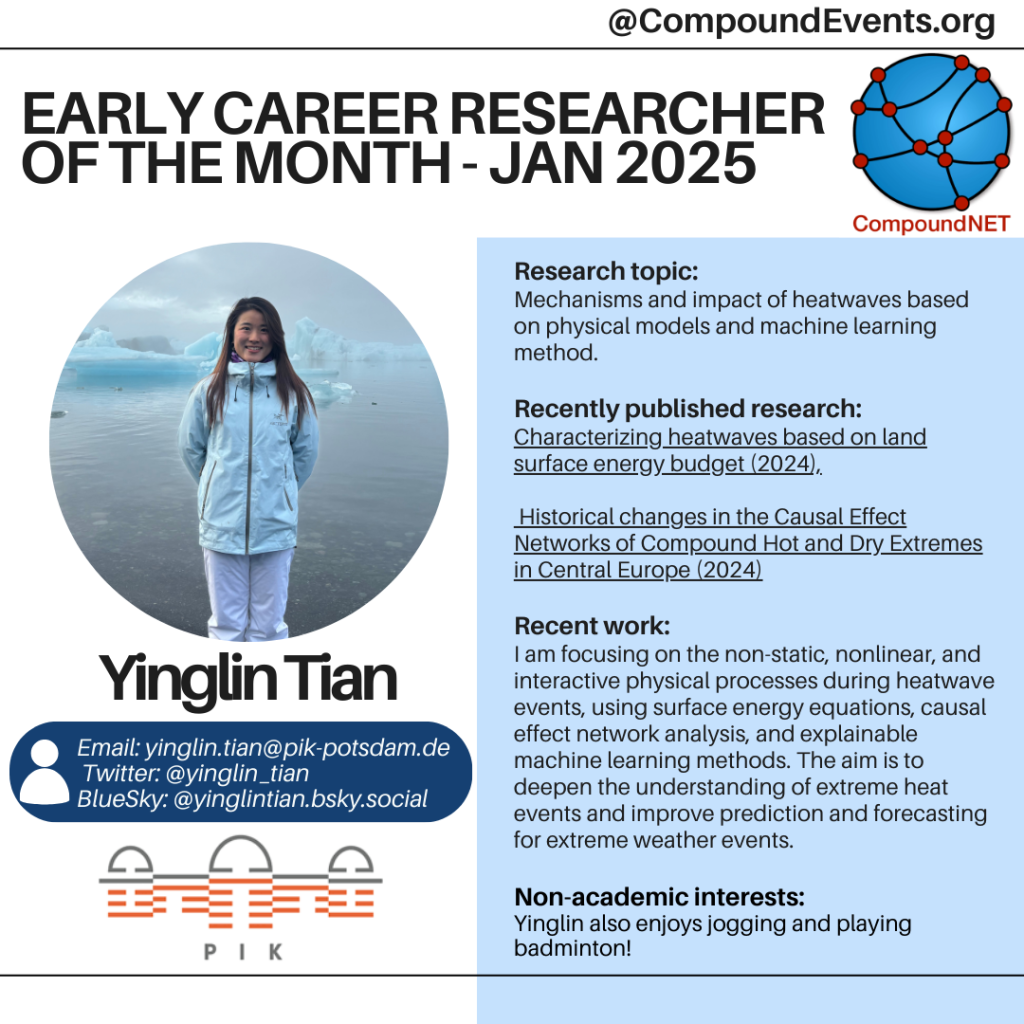
Yinglin earned her PhD in Hydrometeorological Physics in 2024 from Tsinghua University, Beijing and is currently an ECR at the Potsdam Institute for Climate Impact Research (PIK) in Potsdam, Germany. Yinglin’s research currently explores the non-static, nonlinear, and interactive physical processes during heatwave events, using surface energy equations, causal effect network analysis, and explainable machine learning methods. The aim is to deepen the understanding of extreme heat events and improve prediction and forecasting for extreme weather events.
Beyond her professional interests, Yinglin enjoys jogging and playing badminton!
If you are interested in reading more about Yinglin’s research, please find recent articles below, or visit Yinglin’s profile at: https://www.pik-potsdam.de/members/yinglint
Characterizing heatwaves based on land surface energy budget (2024)
https://doi.org/10.1038/s43247-024-01784-y
Historical changes in the Causal Effect Networks of Compound Hot and Dry Extremes in Central Europe (2024)
https://doi.org/10.1038/s43247-024-01934-2
Thanks for reading!
CompoundNET.
Early Career Researcher (ECR) of the Month (November 2024) – Anna Bradley
Published: 2024-12-18 11:49:44Last update: 2025-01-06 16:20:35
By Lou Brett, University of Strathclyde
? We want to hear from you and your exciting research! Always wanted to make your research more visible? If you’re interested in joining the CompoundNET early career network, or even featuring as an EC of the month, this is your chance to ?️ fill out this form.
Our Early Career Researcher (ECR) of the Month for November 2024 is Anna Bradley!
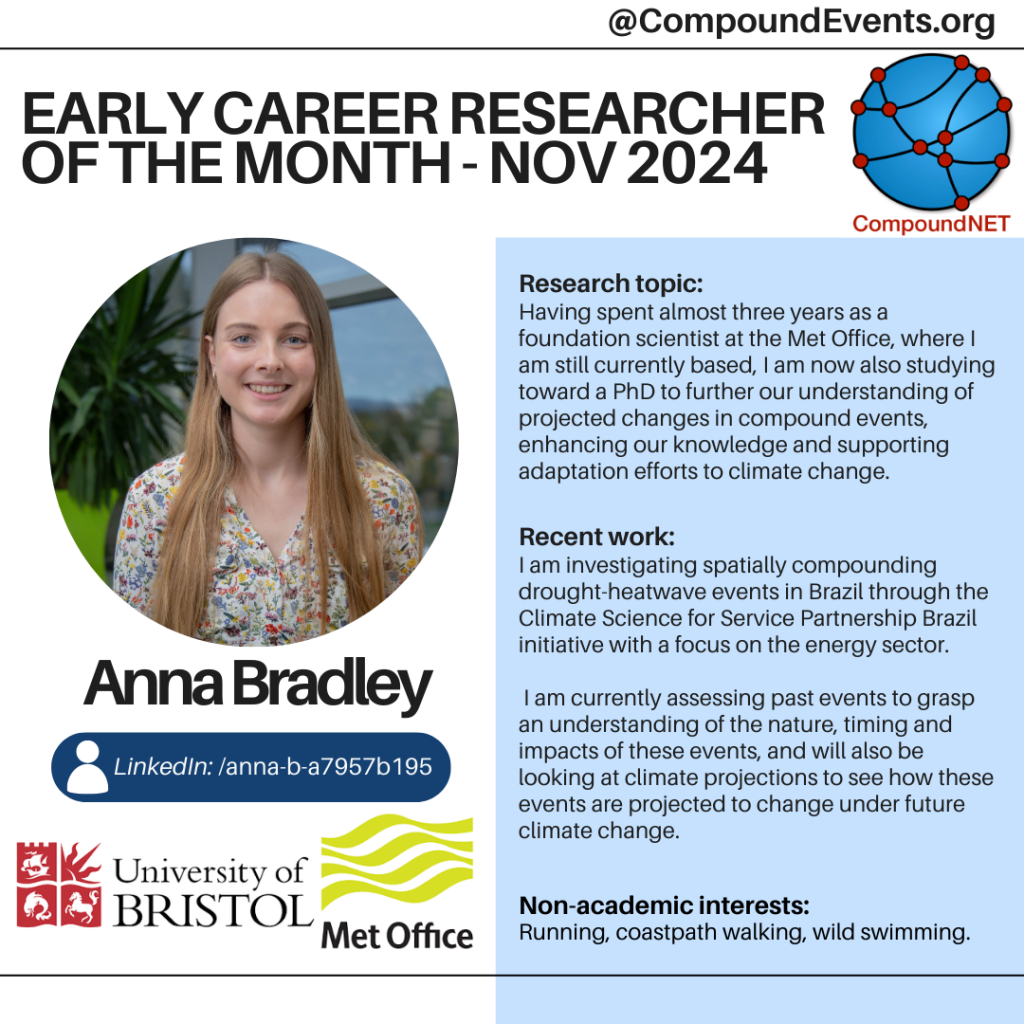
Anna is in the first year of PhD with the Met Office and University of Bristol, UK. Having spent almost three years as a foundation scientist at the Met Office, where Anna is still currently based, she is now also studying toward a PhD to further our understanding of projected changes in compound events, enhancing our knowledge and supporting adaptation efforts to climate change.
Anna’s PhD is investigating spatially compounding drought-heatwave events in Brazil through the Climate Science for Service Partnership Brazil initiative, with a focus on the energy sector. Anna is currently assessing past events to grasp and understanding of the nature, timing and impacts of these events, and will also be looking at climate projections to see how these events are projected to change under future climate change.
We are excited to see how Anna’s PhD progresses!
Outside of work, Anna enjoys running, coastpath walking, wild swimming.
Thanks for reading!
CompoundNET.
Post edited by Pauline Rivoire. Photo credits: Pauline Rivoire (top image), Anna Bradley (portrait).
Early Career Researcher (ECR) of the Month (October 2024) – Toby Jones
Published: 2024-10-25 21:09:59Last update: 2024-10-25 21:09:59
By Lou Brett, University of Strathclyde
? We want to hear from you and your exciting research! Always wanted to make your research more visible? If you’re interested in joining the CompoundNET early career network, or even featuring as an EC of the month, this is your chance to ?️ fill out this form.
Our Early Career Researcher (ECR) of the Month for October 2024 is Toby Jones!
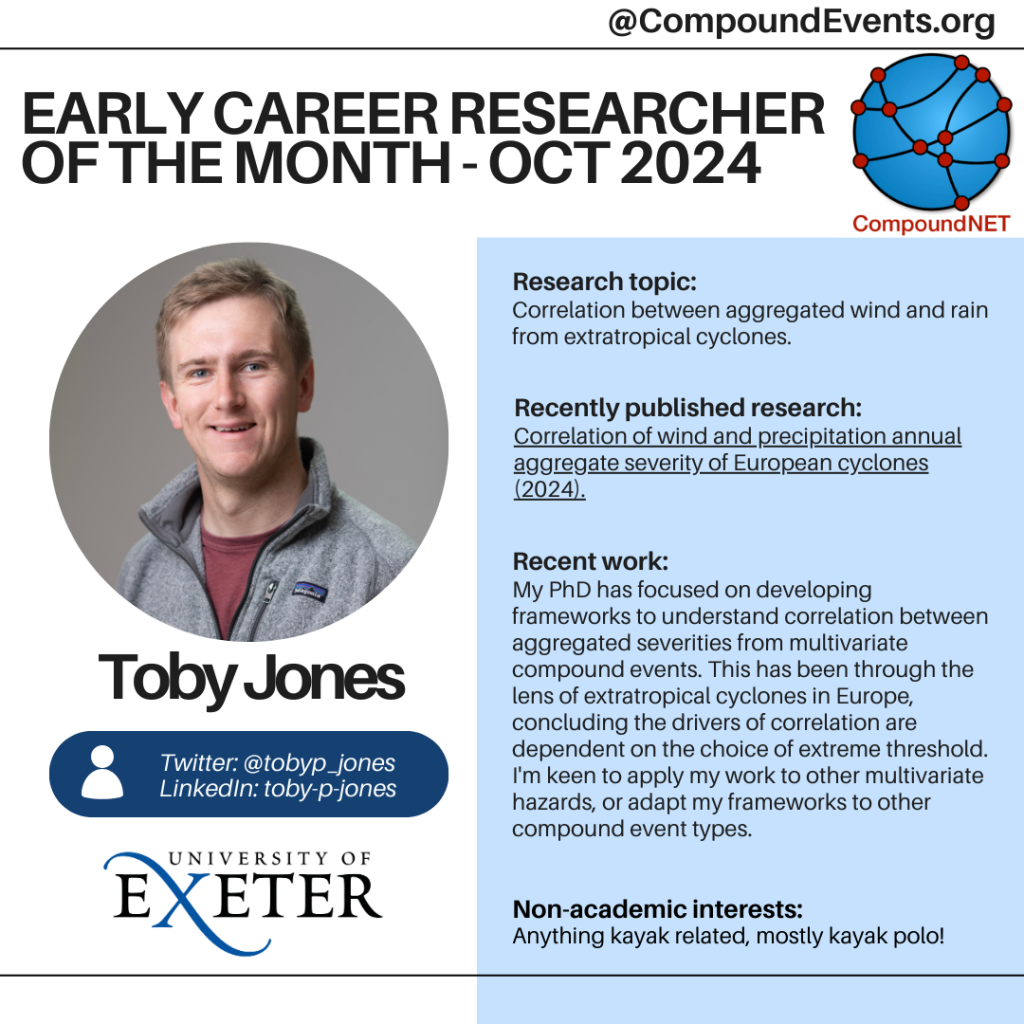
Toby is currently in the fourth year of his PhD at the University of Exeter, UK. Toby’s research explores correlation between aggregated wind and rain from extratropical cyclones
Toby’s Ph.D. has focused on developing frameworks to understand correlation between aggregated severities from multivariate compound events. This has been through the lens of extratropical cyclones in Europe, concluding the drivers of correlation are dependent on the choice of extreme threshold. Toby is keen to apply his work to other multivariate hazards or adapt his frameworks to other compound event types.
If you are interested in reading more about Toby’s research, please find the link beneath:
Correlation of wind and precipitation annual aggregate severity of European cyclones https://doi.org/10.1002/wea.4573
Outside of work, Toby enjoys anything kayak related, mostly kayak polo!
Thanks for reading!
CompoundNET.
Post edited by Pauline Rivoire. Photo credits: Pauline Rivoire (top image), Toby Jones (portrait).
An Actuary in Como - A participant's perspectives on the 3rd compound events training school
Published: 2024-10-18 09:10:19Last update: 2024-10-18 10:15:40
By Mathias Valla, Institut Louis Bachelier (Paris, France) and Aix-Marseille Université (Marseille, France)
An Actuary in Como
It may not seem obvious that climate risk and compound events are hot topics in actuarial science. I get it—when you think of actuaries, your mind probably jumps to spreadsheets, mortality tables, and the intricacies of insurance pricing. But here's the thing: when human life, health, homes, or goods are at stake, the need for risk analysis, protection, and mutualization grows more critical every day. And this is especially true as climate change continues to reshape the landscape of risk. That’s why it’s our collective responsibility to bridge the gap between the technical know-how of climate science and the risk management frameworks we use in actuarial science.
But actuaries are not climate specialists (trust me, I’m one of them). And as much as we like to think we can model everything, there’s a big ol’ knowledge gap between our specialties. That’s what led me to attend the 3rd Como Training School on Compound Climate-Related Events—an intensive crash course in climate science for those of us brave enough to step outside our comfort zones.
Como: Not Just a Pretty Lake
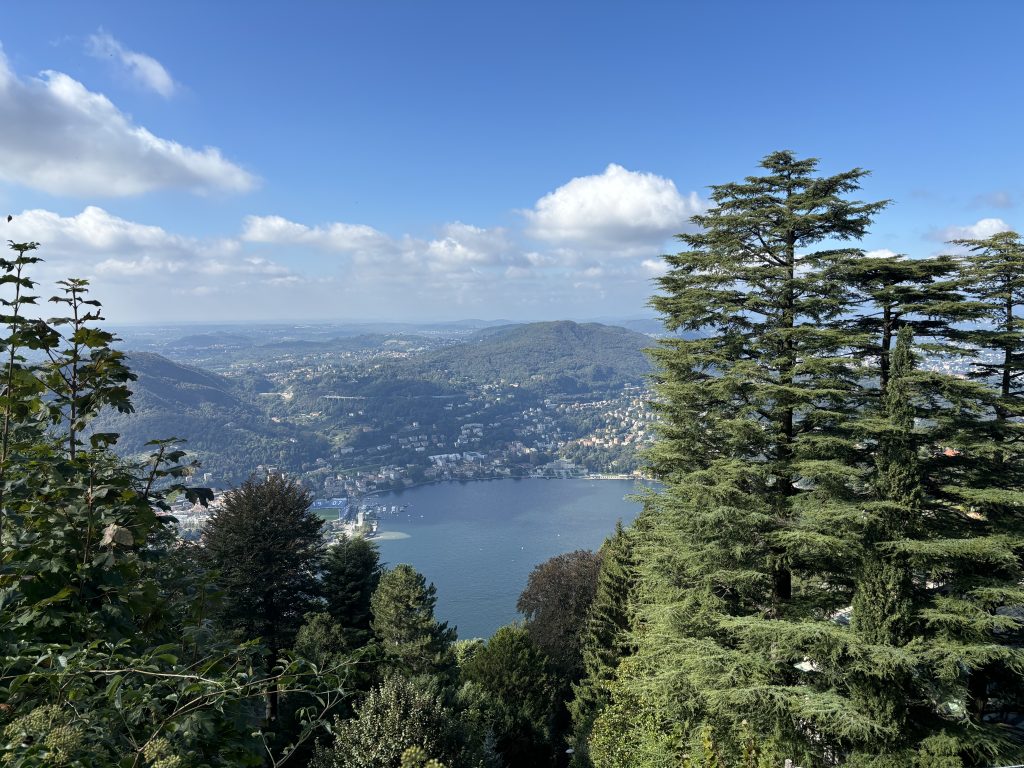
First things first—let’s talk about the setting. Lake Como, Italy. Yes, it's just as beautiful as you’ve heard. Majestic mountains, great for hikes on the weekend? Check. Sparkling blue water perfect for a boat tour? Check. Endless pasta and good coffee? Double check (as long as you don’t order for a blasphemous « americano »). But before you start imagining us lounging by the lake with a spritz in hand (or at Krudo’s, depending on the weather), let me tell you that my time in Como was packed with lectures, projects, and more climate discussion than I ever thought possible.
Walking into the lecture hall, I quickly realized I was surrounded by climate science PhD students, post-doc researchers and lecturers from all over the world who brought their unique perspectives and expertise to the table. The kind of people who can casually throw around terms like "Southern Oscillation Index" and "stationary Rossby waves" as if they’re talking about the weather (well, technically they are). Meanwhile, I’m sitting there thinking, “Okay, how do I tie this all back to actuarial science?” But that’s the fun part, right? Finding those unexpected bridges between two fields.
A Learning Odyssey: Climate Science and Copulas
One of the first things I learned was that climate science loves its data. We’re talking terabyte-sized datasets with multiple variables, locations, and frequencies, all thrown together. And that’s where compound events come into play. In actuarial science, we tend to look at events in isolation, but climate scientists are all about how different variables interact. For example, heavy rains combined with a recent drought can have far worse consequences than just one of those events on its own.
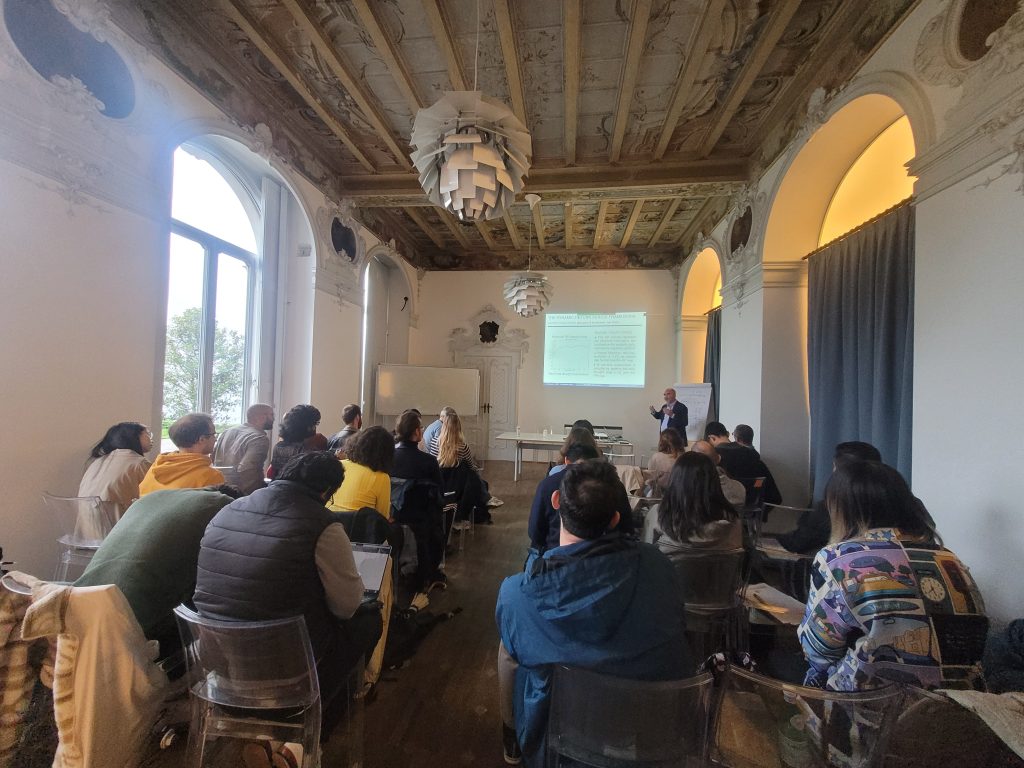
So how do we, as actuaries, make sense of this? Well, the lecture on copulas (courtesy of Fabrizio Durante and Gianfausto Salvadori) delivered that lightbulb moment for me. Copulas, which we use to model dependencies between risks in finance and insurance, are perfect for climate data too! Salvadori introduced the theory behind copulas and their application in hazard assessment, while Durante emphasized quantifying correlation with tools like Kendall’s Tau and tail dependence. These methods can reveal deeper interconnections in climate variables, which is exactly what we need for actuarial climate indices.
The Group Project: Testing our Climate Chops
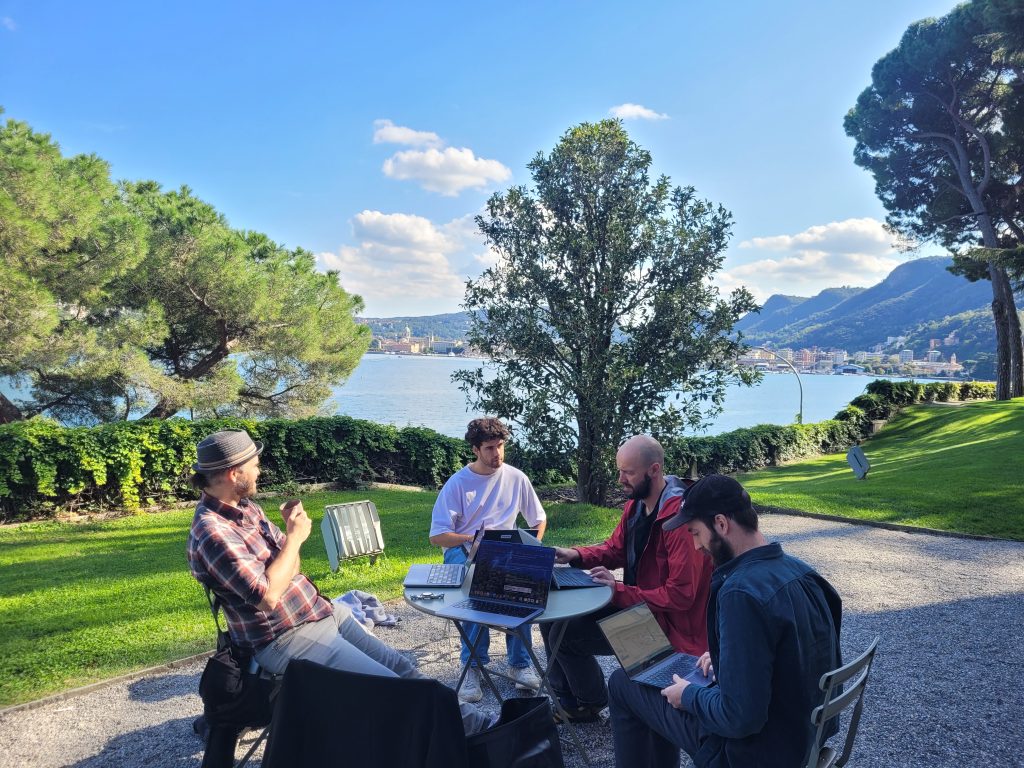
Of course, no academic adventure is complete without a group project! Our team dove into a study on global risks of compound extremes of solar and wind power potential under climate change. Quite the mouthful, right? Basically, we analyzed how the production of renewable energy sources like solar and wind might be simultaneously affected by extreme weather conditions happening at the same time.
I’ll be honest—it was (and still is !) challenging: we are knee-deep in climate data, discussing things like bias correction, downscaling, and energy demand models.
From Como to the Actuarial World
As the week wrapped up, I felt like I had not only survived the Como Training School but had actually thrived in it. Sure, I may not be a climate scientist, but I now have a toolkit that allows me to approach climate risk in a more sophisticated, actuarially sound way.
The takeaway? Actuaries and climate scientists may speak different technical languages, but some of us are working towards the same goal: understanding and mitigating risk. And while climate science might seem daunting at first (especially when you’re sitting in a room full of experts), the overlap between our fields is far more significant than I initially imagined. Plus, getting out of your comfort zone can lead to some pretty exciting breakthroughs.
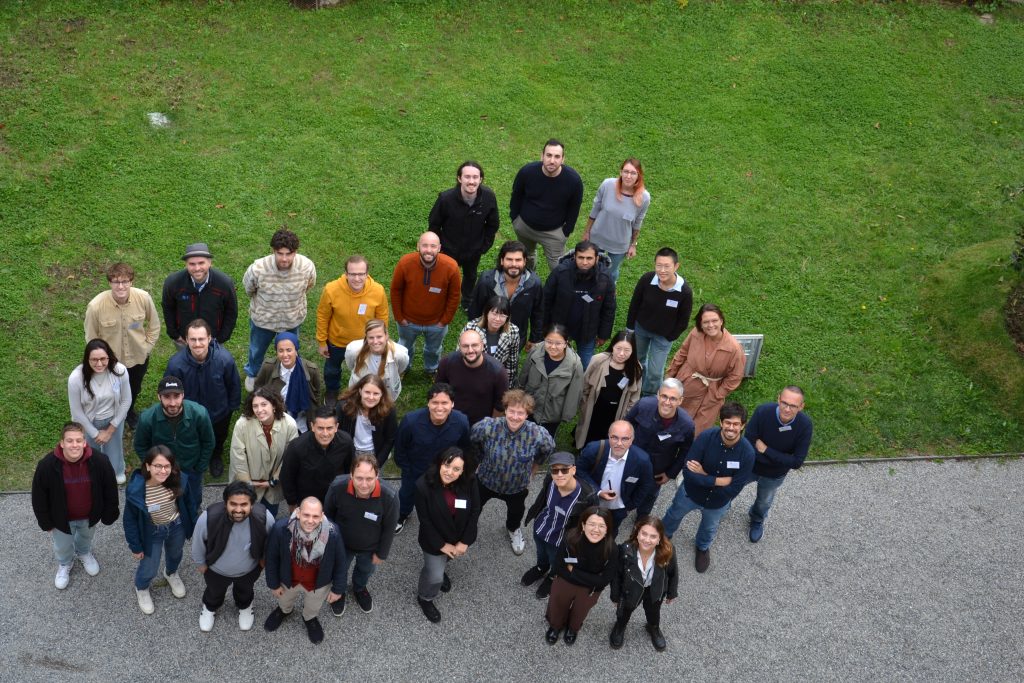
So, to my fellow actuaries: Don’t shy away from climate science. Dive in, attend those conferences, engage with the data and learn from the specialists in those fields : we need this interdisciplinarity. Who knows? You might just find that the next big innovation in actuarial climate indices comes from a compound event analysis or a well-placed Vine copula. And hey, if you can do it from Lake Como, all the better!
And, to my fellow climate scientists: Thank you for the warm welcome into your world of compound events and climate extremes. The work you do is not only impressive, but also vital in understanding the complex risks that lie ahead. Know that climate science is becoming increasingly essential in a range of interdisciplinary research fields, and your expertise is needed now more than ever. You have the power to reshape how we see the world, and I hope more collaborations are born from this synergy between science and risk management.
PS : Before I sign off, I’d like to extend a huge thank you to the organizers and all group project supervisors for this fantastic opportunity. The interdisciplinary environment was truly inspiring, and I’m walking away with new knowledge, great memories, and a deeper appreciation for the global community working to tackle climate risks.
Photo credits: Mathias Valla (top picture); Pauline Rivoire (2nd and 3rd pictures); Fondazione Alessandro Volta (bottom picture). Post edited by Pauline Rivoire.
Early Career Researcher (ECR) of the Month (September 2024) – Sifang Feng
Published: 2024-09-25 07:33:19Last update: 2024-09-25 09:26:06
By Lou Brett, University of Strathclyde
? We want to hear from you and your exciting research! Always wanted to make your research more visible? If you’re interested in joining the CompoundNET early career network, or even featuring as an EC of the month, this is your chance to ?️ fill out this form.
Our Early Career Researcher (ECR) of the Month for September 2024 is Sifang Feng!
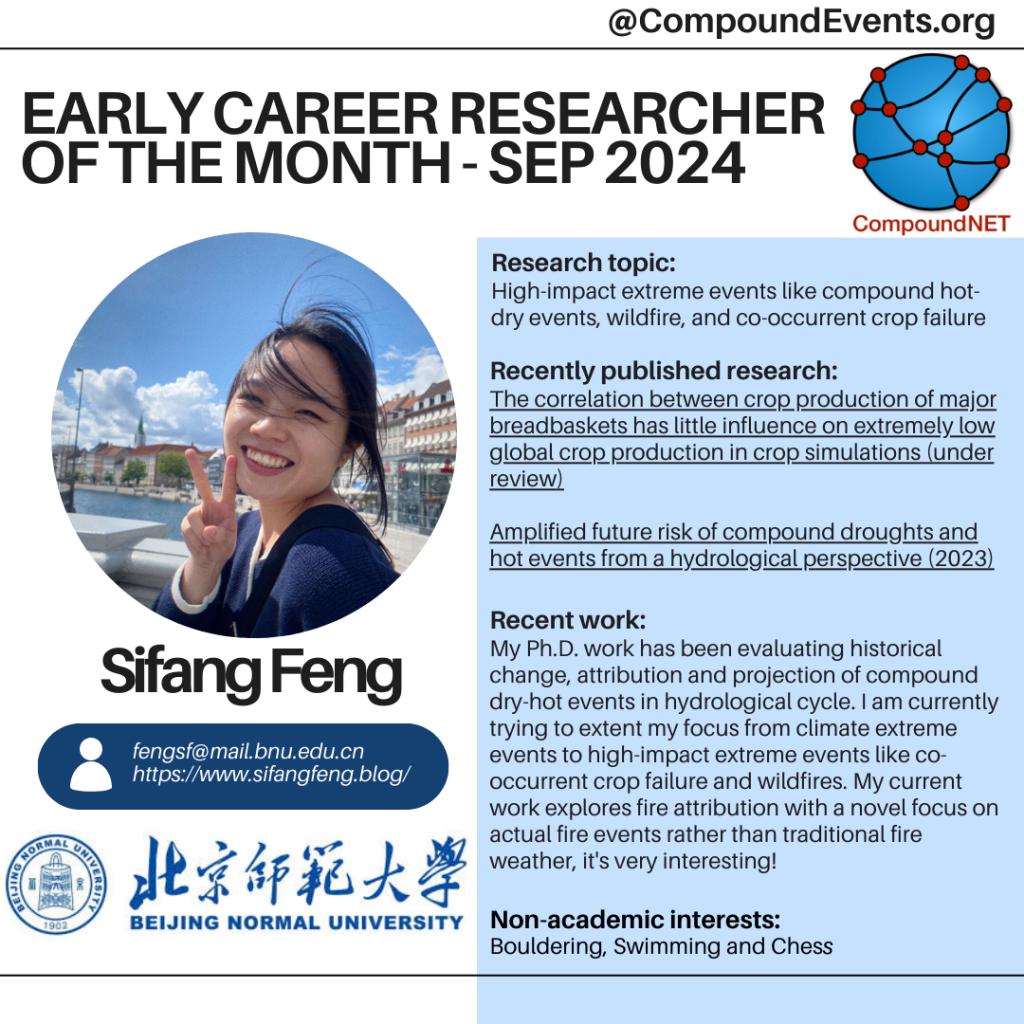
Sifang is currently in the fourth year of her PhD at Beijing Normal University, Beijing, China. Sifang’s research topic explores high-impact extreme events like compound hot-dry events, wildfires, and co-occurrent crop failure.
Sifang’s Ph.D. work has been evaluating historical change, attribution and projection of compound dry-hot events in the hydrological cycle. Recently, she has been trying to extend her focus from climate extreme events to high-impact extreme events like co-occurrent crop failure and wildfire based on climate models and impact models. One completed piece of work quantified the influence of spatial dependence among crop production on global crop loss based on simulation from ISIMIP. Her current work is concentrating on fire attribution with a novel focus on actual fire events rather than traditional fire weather; it’s very interesting!
Outside of work, Sifang enjoys bouldering, swimming and chess.
If you are interested in reading more about Sifang’s research, you can find the links to her published work beneath and at her personal website: https://www.sifangfeng.blog/publications/.
Amplified future risk of compound droughts and hot events from a hydrological perspective (2023). Journal of Hydrology, 617, 129143. https://doi.org/10.1016/j.jhydrol.2023.129143
Climate change impacts on concurrences of hydrological droughts and high temperature extremes in a semi-arid river basin of China (2022). Journal of Arid Environments, 202, 104768. https://doi.org/10.1016/j.jaridenv.2022.104768
Changes in climate-crop yield relationships affect risks of crop yield reduction (2021). Agricultural and Forest Meteorology, 304-305, 108401. https://doi.org/10.1016/j.agrformet.2021.108401
A multi-index evaluation of changes in compound dry and hot events of global maize areas (2021). Journal of Hydrology, 602, 126728. https://doi.org/10.1016/j.jhydrol.2021.126728
Thanks for reading!
CompoundNET.
Post edited by Pauline Rivoire. Photo credits: Pauline Rivoire (top image), Sifang Feng (portrait).
Early Career Researcher (ECR) of the Month (August 2024) – Christoph Sauter
Published: 2024-08-29 12:56:25Last update: 2024-08-29 12:58:48
?We want to hear from you and your exciting research! Always wanted to make your research more visible? If you’re interested in joining the CompoundNET early career network, or even featuring as an EC of the month, this is your chance to ?️ fill out this form.
Our Early Career Researcher (ECR) of the Month for August 2024 is Christoph Sauter!
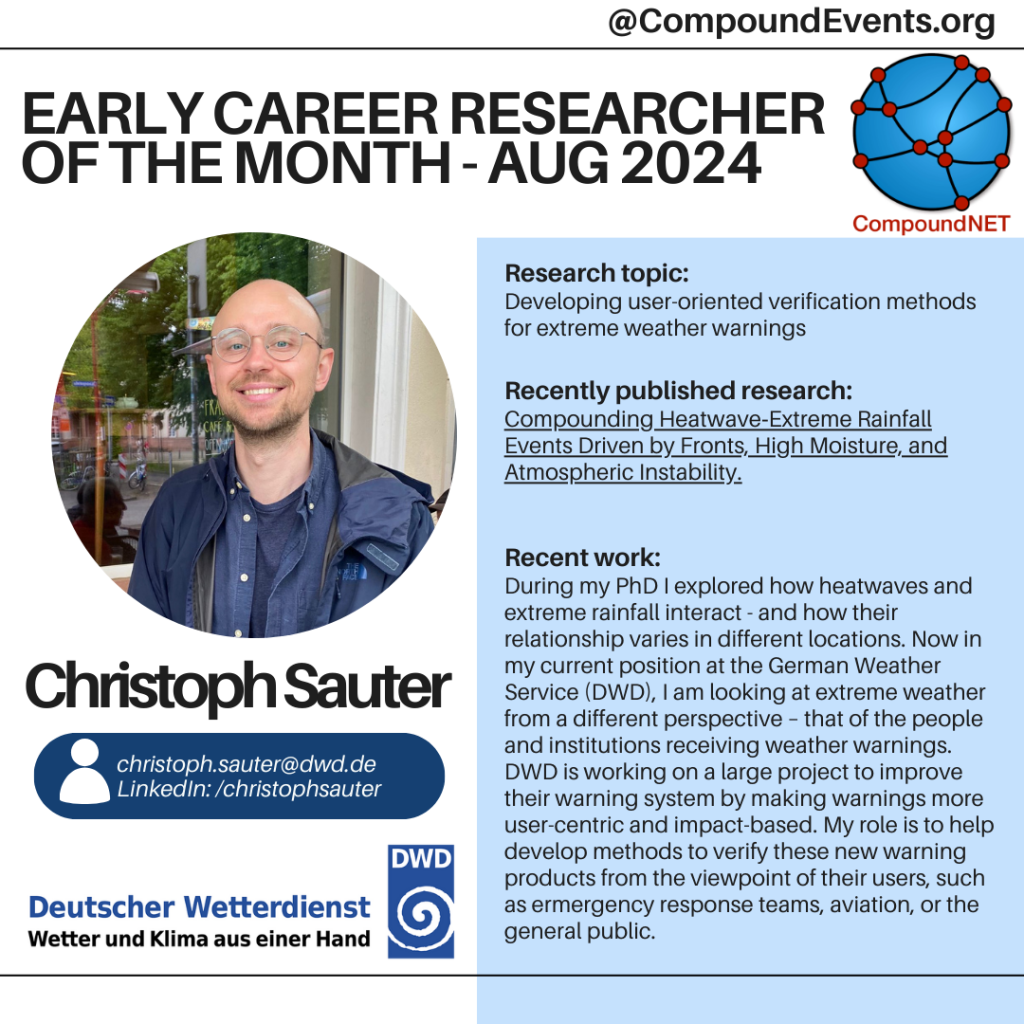
Having completed his PhD exploring how heatwaves and extreme rainfall interact at the University of Strathclyde, Glasgow, Christoph is now working at the German Weather Service (DWD). At the moment, the DWD is working on a large project to improve warning systems by making them more user-centric and impact-based. Christoph’s role is to help develop methods to verify these new warning products from the viewpoint of their users, such as emergency response teams, aviation, or the general public.
If you are interested in reading more about Christoph’s research prior to his new role at the DWD, please find a link beneath:
Compounding Heatwave‐Extreme Rainfall Events Driven by Fronts, High Moisture, and Atmospheric Instability (2023) Journal of Geophysical Research: Atmospheres, 128(21), p.e2023JD038761. URL: https://doi.org/10.1029/2023JD038761
Outside of work, Christoph is an excellent 5-aside football player and is extremely missed on the Strathclyde Civil and Environmental Engineering team.
Thanks for reading!
CompoundNET.
Early Career Researcher (ECR) of the Month (July 2024) - James Carruthers
Published: 2024-08-06 08:45:35Last update: 2024-08-06 08:49:03
By Lou Brett, University of Strathclyde
?We want to hear from you and your exciting research! Always wanted to make your research more visible? If you’re interested in joining the CompoundNET early career network, or even featuring as an EC of the month, this is your chance to ?️ fill out this form.
Our Early Career Researcher (ECR) of the Month for July 2024 is James Carruthers!
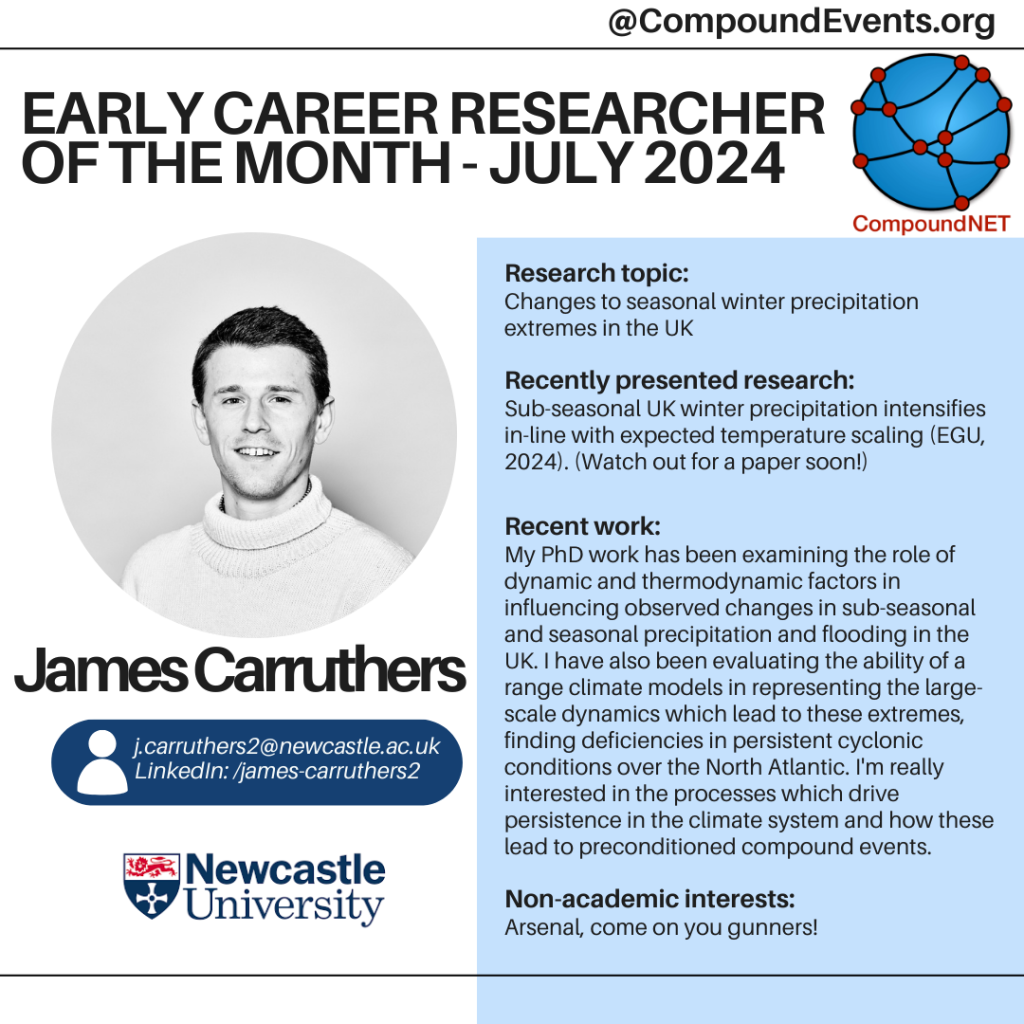
James is currently in the third year of his PhD at Newcastle University, United Kingdom (UK). James’s research topic explores changes to seasonal winter precipitation extremes in the UK.
James’s recent work has been examining the role of dynamic and thermodynamic factors in influencing observed changes in sub-seasonal and seasonal precipitation and flooding in the UK. He has also been evaluating the ability of a range climate models in representing the large-scale dynamics which lead to these extremes, finding deficiencies in persistent cyclonic conditions over the North Atlantic. James is really interested in the processes which drive persistence in the climate system and how these lead to preconditioned compound events.
Outside of work, James is a big Arsenal fan. Come on you Gunners!
If you are interested in reading more about James’s research, please find James’s EGU presentation abstract beneath and keep an eye out for a new paper coming soon!
Sub-seasonal UK winter precipitation intensifies in-line with expected temperature scaling (2024) https://doi.org/10.5194/egusphere-egu24-2365, 2024
Thanks for reading!
CompoundNET.
3rd Como Training School on Compound climate-related Events
Published: 2024-07-10 15:15:58Last update: 2024-07-10 15:15:58
Compound weather and climate events originate from multiple climate drivers that act in combination to amplify societal or environmental risk, posing serious threats to natural systems and human societies. Modelling compound events and their risks under current and future climates requires knowledge about advanced statistical and numerical methods, and about underlying physical mechanisms.
After the success of the first two Training Schools on Statistical Modelling of Compound Events in 2019 and 2022, we are excited to announce the third edition of this school to train the next generation of compound event researchers. The school will provide a comprehensive introduction to compound events and to various statistical approaches and frameworks for their assessment, focusing on key issues like causality, network analysis, dynamics, and impacts.
In addition to lectures from experts in the field, a key component of the school will be group projects to provide a hands-on application of the concepts and to socialize with the other participants and lecturers.
When: 24.09.2024 - 04.10.2024
Where: Lake Como School of Advanced Studies (Como, Italy)
For whom: PhD students and early postdocs (maximum 2 years after completion of PhD). The number of participants is limited to 25.
How to apply: Please send motivation letter (1 page), CV, preference for student project (a list of priority of the proposed projects; see below) and at least one reference (e.g., PhD advisor) as one pdf file to organizerscomoschool2024@gmail.com
Application deadline: 25 August 2024
Notification of acceptance: 1 September 2024
Registration (only accepted students): 10 September 2024
Registration fee: 600 euro (VAT 22% included). The fee covers: all lectures; wi-fi; lunches and coffee breaks; and a social dinner.
Organizing committee: Carlo De Michele, Kai Kornhuber, Jakob Zscheischler, Emanuele Bevacqua, Pauline Rivoire
For information, please contact organizerscomoschool2024@gmail.com
Topics
- Concept of compound events
- Copula theory
- Causality
- Dependence
- Impact modeling
- Machine learning methodologies
- Multivariate extreme value theory
- Physical Drivers and Mechanisms
- Societal Impacts
Lecturers
Prof. Carlo De Michele (Politecnico di Milano, Italy)
Dr. Emanuele Bevacqua (Helmholtz Centre for Environmental Research – UFZ, Germany)
Prof. Manuela Brunner (SLF, Switzerland)
Dr. Mariana M. de Brito (Helmholtz Centre for Environmental Research – UFZ, Germany)
Dr. Giorgia Di Capua (PIK, Germany)
Prof. Reik Donner (Magdeburg-Stendal University of Applied Sciences, Germany)
Prof. Fabrizio Durante (University of Salento, Italy)
Prof. Sebastian Engelke (University of Geneva, Switzerland)
Dr. Kai Kornnhuber (IIASA, LDEO-Columbia University)
Dr. Milan Palus (Czech Academy of Sciences, Czech Republic)
Prof. Simona Sacchi (Università degli Studi di Milano Bicocca, Italy)
Prof. Gianfausto Salvadori (University of Salento, Italy)
Dr. Lisa Thalheimer-Prezyna (United Nations University, Germany)
Student-Project - Instructors
Fabiola Banfi (Politecnico di Milano, Italy)
Taís Maria Nunes Carvalho (UFZ, Germany)
Beijing Fang (UFZ, Germany)
Timothy Lam (PIK, Germany)
Lisa Thalheimer-Prezyna (United Nations University, Germany)
Pauline Rivoire (University of Lausanne and EPFL, Switzerland)
Kevin Schwarzwald (Columbia University, USA)
Student Projects
Participants of the Training School are requested to choose from one of the following 6 student projects. During the two weeks, there will be ample time for the groups to work on their projects, with the intended outcome of each project being a submittable manuscript in the months following the School.
Project 1: “Assessing causality in hot and dry events”
Supervision: Giorgia Di Capua and Timothy Lam
The Mediterranean is a hot spot region for anthropogenic climate change, which has experience both enhanced warming and drying with respect to other regions in the world. Studying atmospheric causal drivers of compound hot and dry events in the region is crucial to identify predictability potential and make informed risk assessments. In this project, we aim to study compound hot and dry events applying causal discovery [Runge, 2018; Runge et al., 2019] and machine learning techniques to both reanalysis data and Coupled model intercomparison project (CMIP) historical and future projections.
References:
Runge J., 2018. Causal network reconstruction from time series: From theoretical assumptions to practical estimation. Chaos 1 July 2018; 28 (7): 075310. https://doi.org/10.1063/1.5025050
Runge J. et al., 2019. Detecting and quantifying causal associations in large nonlinear time series datasets. Sci. Adv. 5,eaau4996(2019). https://doi.org/10.1126/sciadv.aau4996.
Project 2: “Complex network analysis of compounding opposite hydrometeorological extremes”
Supervision: Reik Donner and Fabiola Banfi
Instantaneous co-occurrence of drought and flood conditions in different regions can be triggered by large-scale atmospheric circulation anomalies like blocking patterns, while successions of opposite extremes (even at the same location) may be related to the lifetime of such quasi-stationary states of the atmosphere. Based on available long-term observational and reanalysis data of relevant meteorological and hydrological characteristics, a systematic characterization of compounding opposite hydrometeorological extremes at continental to global scale is attempted by exploiting functional complex network analysis in combination with suitable co-occurrence statistics [Donner et al. 2017; Boers et al. 2019].
References:
Boers, N., Goswami, B., Rheinwalt, A. et al. Complex networks reveal global pattern of extreme-rainfall teleconnections. Nature 566, 373–377 (2019). https://doi.org/10.1038/s41586-018-0872-x
Donner R.V., Wiedermann M., Donges J.F. (2017). Complex Network Techniques for Climatological Data Analysis. In: Franzke CLE, O’Kane TJ, eds. Nonlinear and Stochastic Climate Dynamics. Cambridge University Press; 2017:159-183.
Student project 3: “Compound Extremes, Risk Perception and Climate migration”
Supervision: Simona Sacchi and Lisa Thalheimer
While hazards may be only indirectly influenced by individual and group actions, exposure and vulnerability are directly shaped by the human factor. Consequently, risk estimation models could significantly benefit from psychologically informed insights into human precautionary behavior and adaptation strategies. These factors become even more critical in the case of compound events, where risk information is highly complex and difficult to process cognitively [Sacchi et al. 2022]. In such situations, determining the most appropriate behavioral response can be particularly challenging. Also, psychologically insights may have a key role in the decision processes driving the human migration in response to adverse weather conditions [Thalheimer, 2023].
In this project, we want to investigate empirically, through the development and realization of ad-hoc surveys, the connections between compound extremes and risk perception, and those between risk perception and climate migration.
References:
Sacchi S., Faccenda G., De Michele C. (2022). Risk perception and behavioral intentions in facing compound climate-related hazards. iScience. 26(1): 105787 https://doi.org/10.1016/j.isci.2022.105787
Thalheimer, L. (2023). Compounding Risks and Increased Vulnerabilities: Climate Change, Conflict, and Mobility in East Africa. In: Walker, T., McGaughey, J., Machnik-Kekesi, G., Kelly, V. (eds) Environmental Migration in the Face of Emerging Risks. Palgrave Macmillan, Cham. https://doi.org/10.1007/978-3-031-29529-4_8
Student project 4: “A global database of the impacts of extreme events from text data”
Supervision: Mariana Madruga de Brito and Taís Maria Nunes Carvalho
In this project, we aim to extract detailed information on the impacts of extreme events (e.g., floods, storms, and droughts) based on Red Cross reports. By analyzing these reports, we will gather comprehensive data on both direct and indirect impacts on society and the environment. This includes metrics like fatalities, economic losses, and increases in migration. Since the Red Cross focuses especially on the Global South, we expect to address spatial biases common in global impact databases (e.g., EM-DAT focuses on Europe and the US). To extract structured information from the reports, we will utilize natural language processing (NLP) tools. Our approach will incorporate both supervised classification methods (e.g., Sodoge et al., 2023) and large language models (LLMs) (e.g., Carvalho et al., 2024).
References:
Carvalho T. M. N. et al. (2024, under review) Beyond the surface: leveraging NLP to map global natural hazard impacts. https://openreview.net/forum?id=Jo4tqdIpfX
Sodoge, J., Kuhlicke, C., & de Brito, M. M. (2023). Automatized spatio-temporal detection of drought impacts from newspaper articles using natural language processing and machine learning. Weather and Climate Extremes, 41, 100574.
Student Project 5: “Quantifying the economic impacts from compound extremes”
Supervision Kai Kornhuber, Pauline Rivoire and Kevin Schwarzwald
The increasing frequency and intensity of compound extreme events—where multiple extreme weather conditions occur simultaneously or in close succession—pose significant economic challenges globally, which so far have only been sparsely quantified [1] but are generally missing in the stress testing schemes of large financial institutions and the Insurance Sector. This project aims to quantify the economic impacts of such compound extremes on specific sectors using a range of climate and socioeconomic data sets and the employment of innovative statistical methods. The ultimate goal is to provide a holistic stress testing framework that adequately incorporates currently unaccounted risks posed by compound extreme events.
References:
[1] Compound Risks: Implications for Physical Climate Scenario Analysis; Dolk, Mahul, Ranger, Ceglar, Kornhuber https://www.ngfs.net/sites/default/files/media/2023/11/07/ngfs_compound_risks_implications_for_physical_climate_scenario_analysis.pdf
Student Project 6: “Understanding Changes and Drivers of Spatially-Compounding Floods”
Supervision: Manuela Brunner and Beijing Fang
Floods regularly cause substantial damage globally, emphasizing the urgent need to understand their evolving characteristics and underlying drivers over time for effective risk management. This is particularly crucial for spatially-compounding floods [Berghuijs et al., 2019; Brunner et al., 2020; Fang et al., 2024], which can affect large areas or occur simultaneously across multiple regions, potentially leading to greater impacts than isolated events. Our project will leverage a large-scale flood dataset to identify hotspots of spatial-compounding floods. We aim to investigate how their characteristics change under climate change and uncover the underlying processes driving these changes.
References:
[1] Berghuijs, W. R., Allen, S. T., Harrigan, S., & Kirchner, J. W. (2019). Growing spatial scales of synchronous river flooding in Europe. Geophysical Research Letters, 46(3), 1423-1428.
[2] Brunner, M. I., Gilleland, E., Wood, A., Swain, D. L., & Clark, M. (2020). Spatial dependence of floods shaped by spatiotemporal variations in meteorological and land‐surface processes. Geophysical Research Letters, 47(13), e2020GL088000.
[3] Fang, B., Bevacqua, E., Rakovec, O., & Zscheischler, J. (2024). An increase in the spatial extent of European floods over the last 70 years. EGUsphere, 2024, 1-26.
The Training School is partially supported by
Early Career Researcher (ECR) of the Month (June 2024) – Julia Miller
Published: 2024-06-26 14:54:34Last update: 2024-06-26 15:25:11
By Lou Brett, University of Strathclyde
?We want to hear from you and your exciting research! Always wanted to make your research more visible? If you’re interested in joining the CompoundNET early career network, or even featuring as an EC of the month, this is your chance to ?️ fill out this form.
Our Early Career Researcher (ECR) of the Month for June 2024 is Julia Miller!
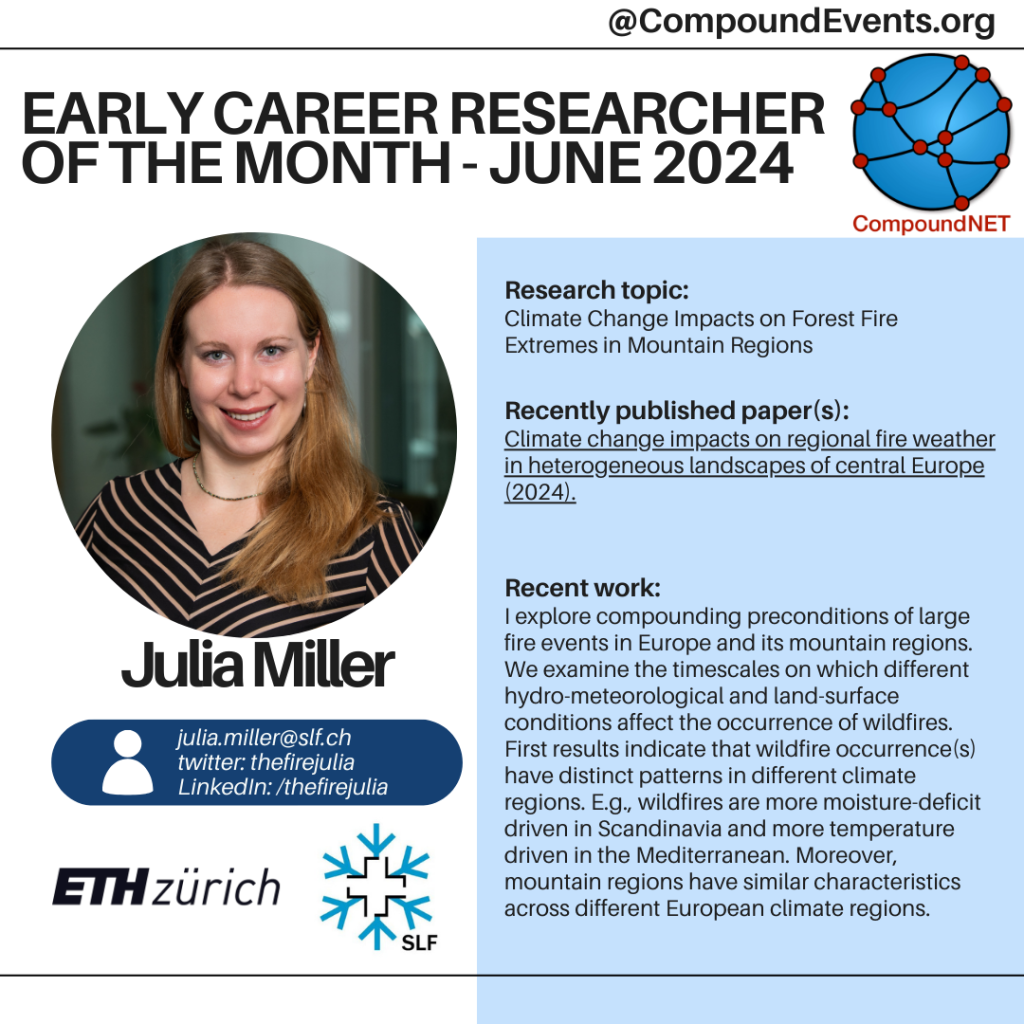
Julia is currently in the second year of her PhD at ETH Zurich & SLF Davos, Switzerland. Julia’s research topic explores climate change impacts on forest fire extremes in mountain regions.
Julia’s recent work addresses the compounding preconditions of large fire events in Europe and its mountain regions. She examines the timescales on which different hydro-meteorological and land-surface conditions affect the occurrence of wildfires. The first results indicate that the occurrence of wildfires has distinct patterns in different climate regions. For example, wildfires are more moisture-deficit driven in Scandinavia and more temperature driven in the Mediterranean. Moreover, findings show that mountain regions have similar characteristics across different European climate regions. Next, Julia wants to explore which compounding relationships of hydro-meteorological and land-surface conditions contribute the strongest to wildfire occurrences.
If you are interested in reading this paper, please find the link beneath:
Climate change impacts on regional fire weather in heterogeneous landscapes of central Europe (2024)-https://doi.org/10.5194/nhess-24-411-2024
Thanks for reading!
CompoundNET.
Photo credits: Pauline Rivoire (top image), Julia Miller (portrait).
A chat with Bart van den Hurk
Published: 2024-06-30 16:39:21Last update: 2025-03-13 08:29:36
By Andreia Ribeiro (Helmholtz Centre for Environmental Research, UFZ) and Cristina Deidda (Vrije Universiteit Brussel, VUB)
Are you ready for an inspiring journey through the minds of leading scientists? In this interview, we introduce Bart van den Hurk. With roles including scientific director at Deltares, Professor at Vrije Universiteit Amsterdam, lead author of the IPCC 6th Assessment Report and co-chair of the IPCC Working Group II, Bart brings unique expertise in weather, climate, and societal impacts. Join us into Bart’s career journey, advice for young researchers, and surprising personal interests. Let’s go? :)
This chat takes place during the ISIMIP workshop 2024 in Potsdam, where during the social dinner, we had the opportunity for a unique conversation with Bart…
“My main advice [to early-careers] is to always stay curious”
"If I were granted one superpower to help science and the world, it would be to make people feel science."
Andreia and Cristina: Hi Bart! Can you walk us through your career journey, highlighting key milestones and experiences?
"My career was always curiosity-driven.”
Bart: "My career was always curiosity-driven. Since high school, I wanted to do something with biology and physics, so I chose Wageningen University to study environmental sciences and got interested in meteorology. I had a special interest in air quality because there weren’t many students in that field, and I wanted to avoid competition.
During my master’s and PhD, I started to develop land-surface models that could be used for weather prediction. After completing my PhD, I joined KNMI as a postdoc, where I continued to work on land surface modeling and regional climate simulations. At the same time, I was introduced to a vibrant international community passionate about land surface modeling. This gave me the opportunity to collaborate with exciting researchers and feel at home in a supportive and friendly community.

In the early 2000s, there was a growing demand for climate scenarios in the Netherlands, particularly for water management. At the time, this was done by a couple of statisticians who looked at the relationship between temperature and rainfall and extrapolated it to a two-degree warming. However, unlike the statistical models, the KNMI regional climate models showed that higher temperatures would increase not only extreme precipitation but also dry spells. This led me to work with water authorities, showcasing the capabilities of regional climate models in predicting changes in precipitation patterns and circulation dynamics.
In 2006, a new version of the climate scenarios based on regional climate modeling was released. These scenarios became a routine product synchronized with IPCC reports. Soon, I became the science director of the climate scenarios and was in charge of the modeling group at KNMI. While developing climate scenarios at KNMI, I continued to explore land-atmosphere interactions and the statistics of extremes in the international arena."
Andreia and Cristina: Could you share a crucial moment in your career that significantly altered your trajectory?

Bart: "Yes, I have a couple of them. The first crucial moment was my introduction to a very special ECMWF researcher. It gave me confidence and played a significant role in my early career development.
The second key moment was becoming the scientific leader of a KNMI project. I took on the responsibility of interacting with stakeholders and laid the groundwork for my future endeavors in this area.
Another key moment was being part of the preparation team for the new organizational structure of KNMI. I was involved in selecting the new director, which significantly impacted the organization. Additionally, I applied for and became a manager in the new structure, overseeing research on climate and water models. This role taught me the importance of leadership while maintaining content expertise and strategic planning.
"I decided not to retire at [where I spent most years of my career] KNMI, and looked for new opportunities.”
Finally, I decided not to retire at KNMI and looked for new opportunities. A friend informed me of a fitting role, leading to a new job where I started immediately. This move was driven by a desire to lead and my curiosity for new challenges."

Andreia and Cristina: What advice would you offer to young and early-career researchers based on your own experiences?
“My main advice [to early-careers] is to always stay curious”
Bart: "Nice question. My main advice is to always stay curious. Always try to find out, 'How does this work?' and 'Why does this work?' This curiosity should apply not only to your science but also to your career. Ask yourself, 'Why am I here?'
It's also important to think about the uptake of your research. Ask, 'Why would anyone care?' Don't rush to make judgments. Stay curious and try to understand before forming an opinion. Understanding why someone behaves a certain way puts you in a better position than judging them.
So, stay curious, and take the time to understand both your science and your career path. This will help you connect with others and make your work more impactful."
Andreia and Cristina: Please share a hobby or interest of yours that most people wouldn't expect.
"I have an active life in my work, but also in my private life. One thing people might not know is that I make furniture."
Bart: "I have an active life in my work, but also in my private life. Maybe that's not unexpected, but one thing people might not know is that I make furniture. I even have a website showcasing my work, and it’s been very nice. I don't have a blog, but I do keep a list of all the music I like and many of the projects I've done at home.
On a more personal note, I have some habits that might be surprising. I get up one hour before I need to leave, for breakfast and read the newspaper. I need this kind of routine; otherwise, I get a bit unsettled. I’m quite 'homey' in that sense."
Andreia and Cristina: If you were granted one superpower to help science and the world, what would it be and why?
Bart: “If I were granted one superpower to help science and the world, it would be to make people feel science. Not just to be informed or aware, but to have an emotional connection with what the science shows. As climate scientists, it's not enough to show how the world will look because that feels too distant for many people. I would want science to make people feel how the world is going to be. It's about creating an emotional touch so people can truly grasp the impact. I believe that it's crucial for inspiring real change.”
Post edited by Andreia Ribeiro and Pauline Rivoire. Photos credits: Desiré van den Berg, from https://www.vn.nl/ipcc-voorman-bart-van-den-hurk/
Early Career Researcher (ECR) of the Month (May 2024) – Richard Leeding
Published: 2024-05-28 06:04:00Last update: 2025-03-13 08:29:46
By Lou Brett, University of Strathclyde
?We want to hear from you and your exciting research! Always wanted to make your research more visible? If you’re interested in joining the CompoundNET early career network, or even featuring as an ECR of the month, this is your chance to ?️ fill out this form.
Our Early Career Researcher (ECR) of the Month for May 2024 is Richard Leeding!
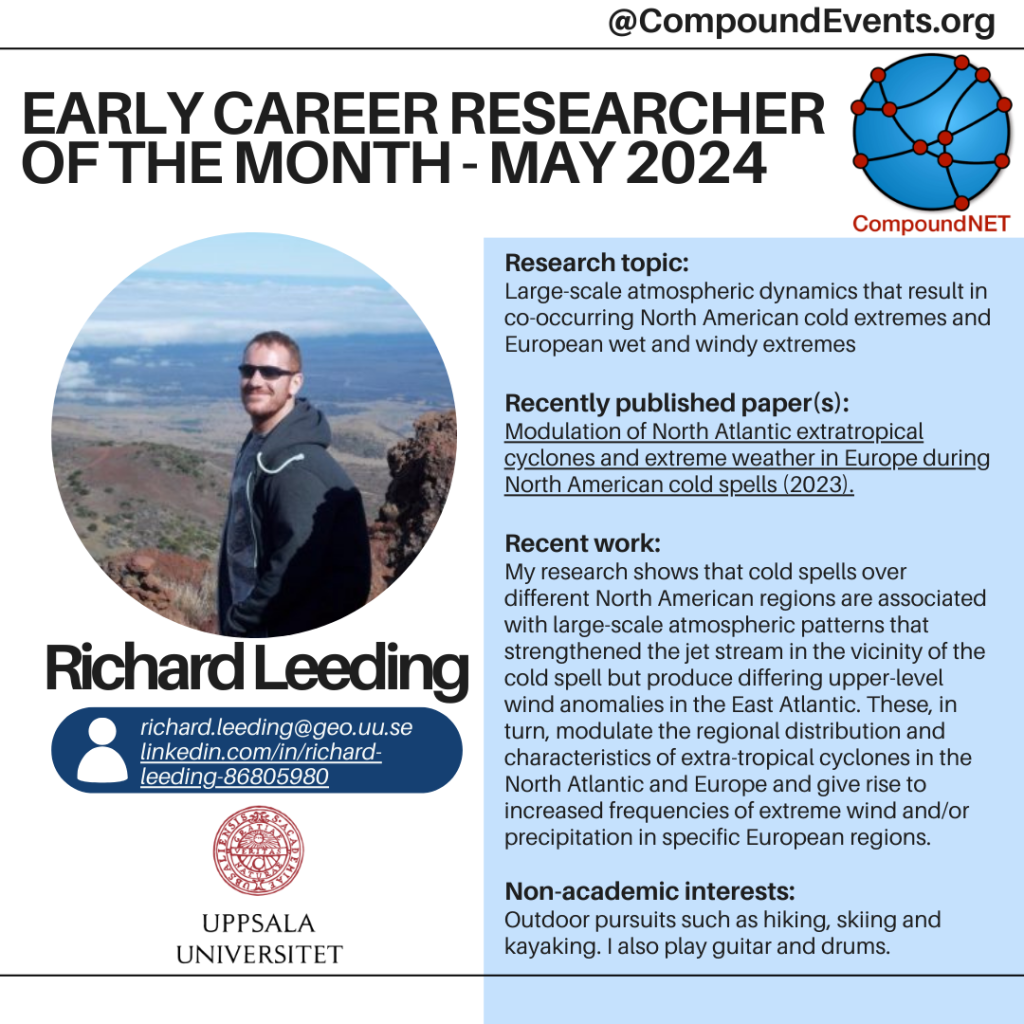
Richard is currently in the final stages of his PhD at Uppsala University, Sweden. Richard’s research topic explores large-scale atmospheric dynamics that result in co-occurring North American cold extremes and European wet and windy extremes.
Richard’s recent work found that cold spells over different North American regions are associated with large-scale atmospheric patterns that strengthened the jet stream in the vicinity of the cold spell but produce differing upper-level wind anomalies in the East Atlantic. These, in turn, modulate the regional distribution and characteristics of extra-tropical cyclones in the North Atlantic and Europe and give rise to increased frequencies of extreme wind and/or precipitation in specific European regions. He also found an increase in the number of extra-tropical cyclones undergoing explosive cyclogenesis during cold spells.
If you are interested in reading this paper, please find the links beneath:
Modulation of North Atlantic extratropical cyclones and extreme weather in Europe during North American cold spells (2023)-https://doi.org/10.1016/j.wace.2023.100629
Thanks for reading!
CompoundNET.
Post edited by Pauline Rivoire. Photo credits: Pauline Rivoire (top image), Richard Leeding (portrait).
Early Career Researcher (ECR) of the Month (Apr 2024) – Kanzis Mattu
Published: 2024-04-22 14:51:50Last update: 2025-03-13 08:29:54
By Lou Brett, University of Strathclyde
?We want to hear from you and your exciting research! Always wanted to make your research more visible? If you’re interested in joining the CompoundNET early career network, or even featuring as an EC of the month, this is your chance to ?️ fill out this form.
Our Early Career Researcher (ECR) of the Month for April 2024 is Kanzis Mattu!
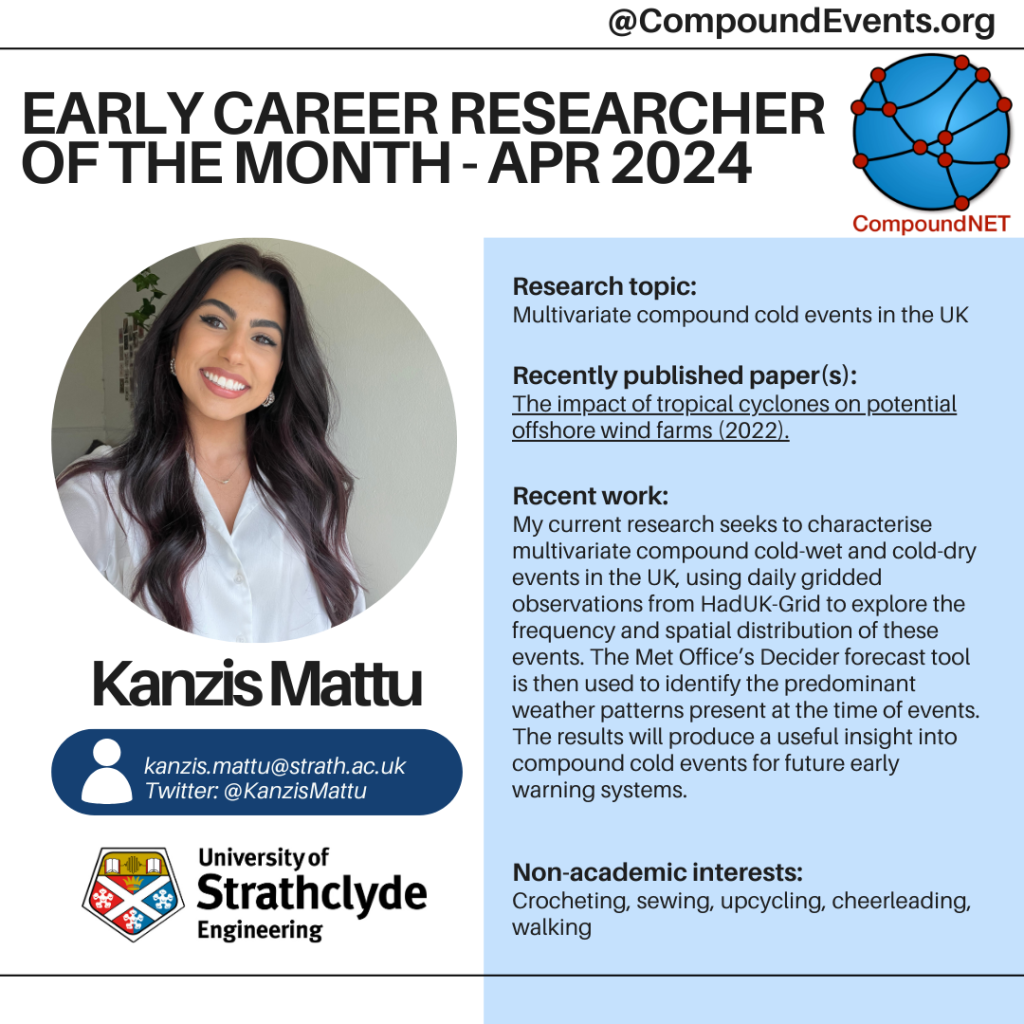
Kanzis is currently in the 2nd year of her PhD at the University of Strathclyde, Glasgow. Kanzis’s research topic explores multivariate compound cold-wet and cold-dry events in the UK.
Kanzis’s work lies in characterising multivariate compound cold-wet and cold-dry events in the UK, using daily gridded observations from HadUK-Grid to explore the frequency and spatial distribution of these events. The Met Office’s Decider forecast tool is then used to identify the predominant weather patterns present at the time of events. The results will provide a useful insight into compound cold events for future early warning systems.
Kanzis has also previously explored the impact of tropical cyclones on potential offshore wind farms. If you are interested in reading this paper, please find the link beneath:
The impact of tropical cyclones on potential offshore wind farms (2022). https://doi.org/10.1016/j.esd.2022.02.005
Thanks for reading!
Post edited by Pauline Rivoire. Photo credits: Pauline Rivoire (top image), Kanzis Mattu (portrait).
Early Career Researcher (ECR) of the Month (Mar 2024) – Henrique Moreno Dumont Goulart
Published: 2024-03-26 07:13:29Last update: 2025-03-13 08:30:00
By Lou Brett, University of Strathclyde
? We want to hear from you and your exciting research! Always wanted to make your research more visible? If you’re interested in joining the CompoundNET early career network, or even featuring as an EC of the month, this is your chance to ?️ fill out this form.
Our Early Career Researcher (ECR) of the Month for March 2024, is Henrique Moreno Dumont Goulart!
Henrique is currently in the final stages of his PhD at Deltares and IVM-VU Amsterdam. Henrique’s research topic explores storylines of high-impact water-related compound events and risk assessment under climate change.
Henrique’s work lies in helping to bridge the gap between climate sciences and (water-related) impact sectors, such as simultaneous crop failures and compound floods due to storms. His most recent work analyses the different ways that an extreme event (Hurricane Sandy, 2012) could have impacted a given place by exploring different climate scenarios, including climate change and internal climate variability. For that, Henrique used storylines in an extensive modelling framework, linking climate information to actual impact estimation.
If you are interested in reading this paper or Henrique’s other recently published research, please find the links beneath:
Increase of Simultaneous Soybean Failures Due To Climate Change (2023)- https://agupubs.onlinelibrary.wiley.com/doi/full/10.1029/2022EF003106
Compound flood impacts from Hurricane Sandy on New York City in climate-driven storylines (2024)-
https://doi.org/10.5194/nhess-24-29-2024
Post edited by Pauline Rivoire. Photo credits: Pauline Rivoire (top image), Henrique Moreno Dumont Goulart (portrait).
Early Career Researcher (ECR) of the Month (Feb 2024) – Lily-belle Sweet
Published: 2024-02-29 10:11:03Last update: 2024-02-29 10:11:03
By Lou Brett, University of Strathclyde
? We want to hear from you and your exciting research! Always wanted to make your research more visible? If you’re interested in joining the CompoundNET early career network, or even featuring as an EC of the month, this is your chance to ?️ fill out this form!
Our second Early Career Researcher (ECR) of the Month for February 2024, Lily-belle Sweet!
Lily-belle is currently completing her PhD at the Helmholtz Centre for Environmental Research -UFZ Leipzig. Lily-belle’s research topic explores using interpretable or explainable machine learning to identify compounding climate drivers of agricultural yield failure.
Lily-belle is currently using data-driven methods to identify climate drivers of impacts such as agricultural yield shocks, with particular focus on the interactions between driving events. Lily-belle is also one of the coordinators of the AgMIP Machine Learning team (AgML), which was initiated during a Short-Term Scientific Mission to NASA GISS in New York (Check out her blog post here!). Her most recent work explores the importance of cross-validation strategy when using machine learning on spatiotemporal data, for model performance and interpretation via permutation feature importances (a frequently-used tool for identifying drivers of climate impacts).
If you are interested in reading this paper further, please find the link beneath:
Cross-validation strategy impacts the performance and interpretation of machine learning models, Sweet et al. (2023), Artificial Intelligence for the Earth Systems, URL: https://doi.org/10.1175/AIES-D-23-0026.1
Post edited by Pauline Rivoire. Photo credits: Pauline Rivoire (top image), Lily-belle Sweet (portrait).
From a Short-Term Scientific Mission to the Creation of a Community for Machine Learning and Crop Modelling
Published: 2024-02-27 12:24:36Last update: 2024-02-27 13:33:20
by Lily-belle Sweet, Helmholtz Centre for Environmental Research (UFZ)
Existing crop models underestimate the impacts of individual climate extremes on yields, but agricultural yield shock can also be caused by the compounding effect of multiple, more moderate, weather events. My PhD research, supervised by Jakob Zscheischler at the Helmholtz Centre for Environmental Research (UFZ), is centred on the use of interpretable or explainable Machine Learning (ML) methods to identify interacting climate drivers of agricultural yield failure, both in process-based crop models and observation.
As well as using interpretable ML to analyse and intercompare existing agricultural models, ML can also be used to generate or gap-fill input data required for driving the models, to post-process simulations (for example, by downscaling) or to replace components of agricultural models in hybrid modelling approaches. These approaches could improve our ability to capture the complex effects of compound events on agricultural systems, and better understand how they will be affected under climate change. However, advances in this intersection of disciplines require both ML expertise and deep domain knowledge.
For my STSM within the COST action DAMOCLES, I was able to visit Alex Ruane and the Climate Impacts group at the NASA Goddard Institute for Space Studies in New-York City from January to February 2023. The aim of the visit was to review the current state-of-the-art and identify opportunities in research combining ML methods with current process-based crop modelling approaches, and, in collaboration with the Agricultural Modelling Intercomparison and Improvement Project (AgMIP), to establish a community of practice for ML in agricultural modelling. As part of the visit, we organised a one-day workshop at NASA GISS along with Ioannis Athanasiadis (WUR) to discuss these ideas and begin outlining our goals for the team.
As I flew back to Germany, I was excited, but also nervous; would other researchers find our ideas compelling, and be interested in joining the collaborations we envisioned? The STSM was an incredible opportunity to learn from so many great researchers from multiple disciplines - this type of interdisciplinary connection and knowledge-sharing is exactly what I hoped to facilitate. As it turned out, thanks to the support and mentorship of Alex, Ioannis and Jakob, the community has grown and flourished more than I could have imagined.
The deep discussions and takeaways from the STSM were used to inform our planning of several ML-focused sessions at the 9th AgMIP Global Workshop which took place at Columbia University in June. Since then, the community (AgML) has been meeting every two weeks via Zoom and working together on coordinated activities to create carefully-curated benchmark datasets and robustly evaluate the utility of different ML methods for various agricultural modelling applications. In late January 2024, we organised the first AgML workshop at Wageningen University, with around 35 in-person attendees from all around the world. We are actively working on two collaborative activities, with several more in the early stages of development.
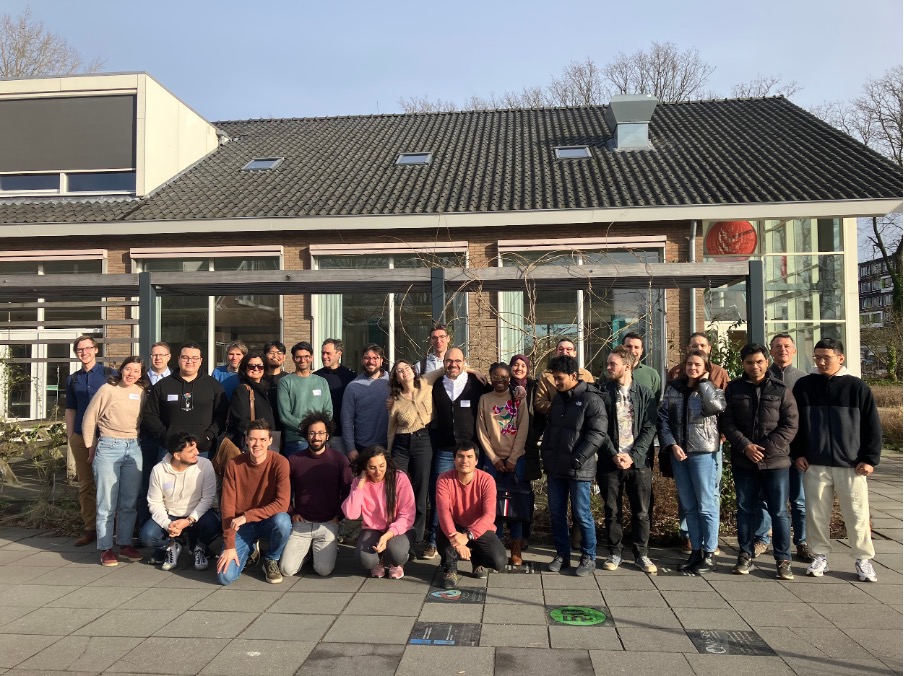
In the study of compound events, researchers often work with large model simulations, sometimes from multiple impact sectors. Having a closer connection with the crop modellers and scientists from other disciplines involved in the production of these datasets has widened my scientific perspective and facilitated my research enormously. I hope to maintain, and strengthen, these links between Machine Learning, agricultural modelling and compound events communities in the future.
Edited by Pauline Rivoire. Photo credits: Lily-Belle Sweet (top picture); AgML and Ioannis Athanasiadis (bottom picture).
Early Career Researcher (ECR) of the Month (Jan 2024) - Bastien François
Published: 2024-01-24 17:52:59Last update: 2025-03-13 08:30:08
By Lou Brett, University of Strathclyde
Happy New Year!
Exciting news! We are launching an Early Career of the Month series, showcasing the incredible work of young scientists in CompoundNET. ? We want to hear from you and your exciting research! Always wanted to make your research more visible? If you’re interested in joining the CompoundNET early career network, or even featuring as an EC of the month, this is your chance to ?️ fill out this form!
New Year - new opportunities: We’re very pleased to launch our first Early Career Researcher (ECR) of the Month for January 2024, Bastien François!
Having completed his PhD in Applied Statistics for Climate Science at the Université Paris-Saclay, Bastien is now working at the Royal Netherlands Meteorological Institute (KNMI) as a postdoctoral researcher. Bastien currently researches compound event probabilities and their evolution with climate change. Following a compound events summer school in Budapest, 2022, Bastien is currently working on the influence of climate modes such as El Niño-Southern Oscillation (ENSO) on the occurrences of wind and precipitation extremes.
Another recent study by Bastien proposes a new methodology to assess the time of emergence of compound events probabilities and to quantify the contribution of univariate and dependence properties to the overall probability changes. The methodology is applied to a 13-member multi-model ensemble (CMIP6) to analyze wind and precipitation extremes and false springs events. The results show that the time of emergence of probabilities as well as the importance of univariate and dependence properties can differ from a compound hazard to another, and from a climate model to another. It shows the importance of considering changes in univariate and dependence properties, as well as their inter-model variability, for future risk assessments related to compound events.
If you are interested in reading this paper further, please find the link beneath:
Time of emergence of compound events: contribution of univariate and dependence properties, François and Vrac (2023), Nat. Hazards Earth Syst. Sci., URL: https://nhess.copernicus.org/articles/23/21/2023/
Post edited by Pauline Rivoire. Photo credits: Pauline Rivoire (top image), Bastien François (portrait).
Workshop in Karlsruhe about the future of the compound events community - The CompoundNET and future directions
Published: 2024-01-07 15:35:47Last update: 2025-03-13 08:30:14
by Katharina Küpfer, KIT
In November 2023, about 30 researchers from 21 research institutes across Europe and the world gathered in Karlsruhe, Germany for a workshop, hosted by Alexandre Ramos (KIT). After DAMOCLES came to an end in March 2023 (see earlier blog post), the primary goal was to define the way ahead in Compound Events research. The workshop resulted in a comprehensive agenda with an ambitious roadmap for the next years regarding scientific events as well as enhanced science communication.
Kicking off with an outline on the state of the community within compound and multi-hazard research, all participants were brought up to speed on the community evolution from its beginnings to its current state. This was followed by many different engaging pitches by participants on scientific ideas, e.g. model evaluation or complex disaster risk types, for the future development of the Compound Events field, as well as pitches on existing and potential organizational formats.
New directions in Compound Events research
After an inspiring dinner with lots of room for updates and networking, the workshop continued on Day 2 with a discussion about new possible directions in Compound Events research. Within several breakout groups, different topics were discussed with respect to Compound Events, such as impact data, testing and validating models, bias adjustment methods, prediction approaches and communication of high-risk climates and events.
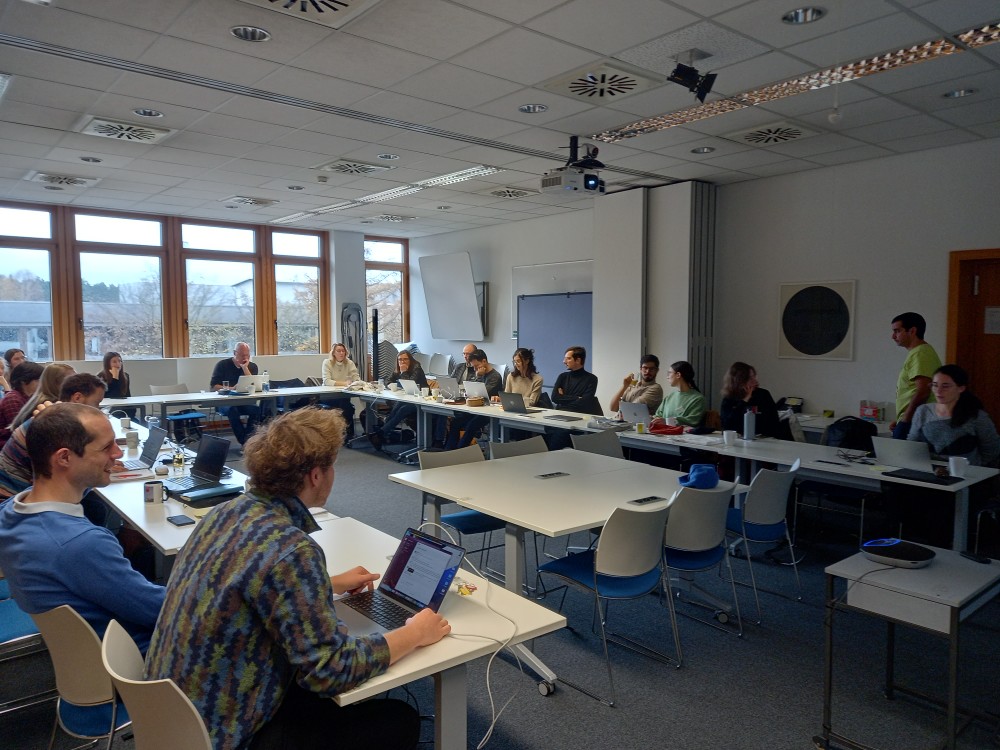
Future organization of the community – Workshops and Science Communication
One breakout group dealt with future workshops and conferences – many different workshops, summer schools and even conferences were planned and lead persons identified, with a timeline ranging from late 2024 to 2026 and locations all over Europe. This paves the way for numerous exciting scientific meetings targeted towards different aspects of Compound Events soon to come. Stay tuned!
Another group focused on scientific communication and assigned roles for website coordinators, co-coordinators as well as an Early Careers Board. Communication channels and the structure of our website were discussed as well as plans made for future blog posts.
A new name and logo for the community – fostering science communication and network building
A new name was sought for the Compound Events community following the conclusion of the DAMOCLES Cost Action. In a dynamic workshop discussion, numerous ideas were passionately brainstormed and thoroughly discussed. The best ideas were put on X (formerly Twitter) for a poll – and we have a winner: CompoundNET (Compound Events NETwork)! A new logo was also created, which completes the new shape of CompoundNET:

Although an unexpected train strike forced many many participants to leave early, the workshop ended up being a full success. We now have a clear picture of what lies ahead for CompoundNET with many promising scientific events, improved science communication and even a rebranding.
How to stay connected
On further news, we are also now present on Bluesky @compoundnet.bsky.social https://bsky.app/profile/compoundnet.bsky.social. Stay connected via X, Bluesky and this blog for CompoundNET updates. Additionally, follow the Risk KANkan website, mailing list, newsletter, and webinars: https://www.risk-kan.org/working-group-compound-events-and-impacts/.
We are looking forward to the next years, together with your participation!
Post edited by Christoph Sauter, Pauline Rivoire, and Andreia Ribeiro. Photo credits: Svenja Christ (top image), Katharina Küpfer (bottom image).
End of DAMOCLES – how to stay connected with the compound events community
Published: 2023-09-29 13:51:55Last update: 2023-10-09 15:24:16
by Cassandra Rogers, Climate Scientist at the Bureau of Meteorology, Australia
Sadly, DAMOCLES officially came to an end in March, 2023. But there are other opportunities to stay connected with the compound events community. The Risk KAN Working Group on Compound Events and Impacts aims to facilitate the development of an international, transdisciplinary network of researchers interested in compound events and their impacts. Going forwards, the two groups will join forces for future actives, such as webinars, workshops, conferences, and training schools.
This website and the Risk KAN working group website will help you connect with the compound events community. The links below might be particularly useful:
- Upcoming events
- Recordings of previous webinars
- Risk KAN compound events and impacts working group website
- Join the mailing list
- Submit items for our newsletter
- Upcoming events
- Newly published papers
- Notable recent examples of compound events
- Twitter: @Compound_Event (previously the DAMOCLES Twitter)
- Risk KAN on LinkedIn
We hope to see you at an upcoming event soon!
Post edited by Andreia Ribeiro. Photo by Cassandra Rogers.
COST DAMOCLES final conference brought global experts together to work on compound weather events
Published: 2022-11-07 11:27:31Last update: 2022-11-15 08:34:49
Blog post written by:
Minna M. Keinänen-Toivola
Satakunta University of Applied Sciences, COST DAMOCLES WG2 leader
European scientists and experts have co-worked on compound events in the COST DAMOCLES project for the past four years. The results of DAMOCLES were presented, and next steps of co-operation were discussed at the final conference which was organized in sunny Lisbon, Portugal.
The final conference was entitled “Perspectives and ways forward in Compound Event research” and consisted of two and half full days of presentations from Tuesday to Thursday 6th to 8th of September 2022. In this blog post, I highlight some of the presentations.
The conference started with a session on case studies of compound events. The main local organizer Alexandre Ramos presented compound events related to fires in Portugal in 2017. Two representatives from a global insurance company told they are developing a model on compound events, which can be used when defining the insurance costs and payments after an incident.
The second session “Historical Events & Socio-economic Impacts” had presentations not just from Europe, but also from USA and China. Compound events are a global issue, not just a challenge for Europe. One very recent compound event was presented by prof. Miguel D. Mahecha – a fish kill in the Oder river in summer 2022. It turned out that the fish kill was due to algal bloom, containing toxin that prevented the fish from breathing. The algae need salty water to grow, which was available due to an industrial pollution upstream. Prof. Mahecha’s presentation highlighted that compound events are not “just” physio-chemical events but often contain also a biological component.
Tuesday afternoon had several training school presentations. The concept of DAMOCLES training schools was new to me. The latest training school was held for two weeks in Budapest, Hungary in July 2022. There had been a high interest towards the training school as only half of the applicants could be accepted. The training school in Budapest had research questions/themes to student groups consisting of three to five Ph.D. students. Each group had two to three supervisors from COST DAMOCLES scientist and experts. The groups worked on their theme and the goal was a joint scientific article. During the Lisbon meeting, the summer school results were not only presented, but students also wrote the articles further. However, the training school had not been just about science but also about professional networking and making friends.
On Wednesday, I was chairing the third session: “The Drivers of Compound Events”. Keynote speaker Dr. Nicholas Simpson from South Africa presented the drivers for climate risks, which are hazard, vulnerability, exposure and response. As a case example he used the risk on food security. Dr. Simpson also highlighted that risks also interact, which makes the evaluation and management of risks demanding. The other presentation in the session covered drought and flooding themes. The fourth session “Statistical and Physical Modelling” consisted of a lot of mathematics and statistics. On Wednesday afternoon, we enjoyed vice chair of action prof. Bart van den Hurk’s program for activating body to activate brains.
On Thursday the last session of the conference was “Forecasting, Trends, and Projections”. Keynote speaker Dr. Nina Nadine Ridder from Australia highlighted the reality most of the humans will face in the coming decades. She stated:
- ”95% of the world population will see an increase in hot and dry event frequency by the end of the 21st century”
- “63% of the world population experience a tenfold increase in the number of compound events.”
Another very interesting presentation was held by Dr. Indiana Olbert as she presented a statistical, hydrodynamic and machine learning modelling of compound flooding in Cork, Ireland. The research team also has started vast co-operation with experts of various sectors, such and social scientists and economics on flooding compound events for better preparedness as well as to increase public awareness. The compound flooding is a real threat also in the Satakunta region, especially in the Kokemäenjoki river area.
Poster sessions were organized on both days. The most important posters for me were from the Baltic Sea area. Dr. Piia Post from Estonia presented the poster “The role of multiple drivers in forcing large volume changes of the Baltic Sea”. Poster sessions were social events.
On Thursday afternoon, M.Sc. Louise Brett from UK presented the progress within compound events research in the last ten years. COST DAMOCLES has influenced the publication of scientific papers dramatically. Brett highlighted that there is still lack of compound event research on extreme low temperature as well as on the continent of Africa.
The conference ended to a summary by the chair of the action Dr. Jakob Zscheischler. Dr. Zscheischler highlighted that COST DAMOCLES has been a success achieving its goal. COST DAMOCLES will still have a couple of workshops before the end in March 2023. However, science and co-operation in the field of compound events continues in various forms. Most importantly, not only European, but a global, active network is established on compound event research heading for true stakeholder involvement.


PhD position in data science and the dynamics of multi-hazard risk
Published: 2021-05-12 18:06:57Last update: 2021-05-12 18:12:45
Do you want to contribute to the sustainable management of natural hazards? Do you want to work on multi-hazard risk science? And do you want to do this in a team of outstanding water and climate scientists? Then, please apply for this PhD position at Vrije Universiteit Amsterdam.
JOB DESCRIPTION
You will work on research leading to a PhD thesis on assessing the dynamics of multi-risk due to interactions between different natural hazards. Risk models have been developed to assess changes in risk in the past and future due to changes in hazard, exposure, and vulnerability. However, they examine long-term trends, assuming no interactions between risk drivers. Dynamic feedbacks are poorly represented, and we lack methods to assess and quantify changes in risk over time. This project aims to build an evidence and knowledge base of how multi-hazards influence dynamic feedbacks between risk drivers and thereby influence overall risk.
The position entails: (1) developing data-driven approaches for identifying empirical evidence of dynamics and feedbacks of risk drivers and past multi-risk interactions, (2) quantifying these dynamics and feedbacks, and (3) developing functions that account for interactions between multiple hazards and Disaster Risk Reduction measures. The research will contribute to the development of a database of feedbacks between risk drivers. Methods include advanced machine learning techniques, such as generative models or neural networks, and short- and long-term time-series analysis accounting for spatial and temporal dynamics.
This research is part of a large EU-funded project, MYRIAD-EU. The work will be carried out at the Institute for Environmental Studies (IVM) at VU Amsterdam. You will work in close collaboration with our consortium partners, including the Max Planck Institute, IIASA, Deltares, and CMCC. The results will be used to inform decision-making related to the Sustainable Development Goals and the Sendai Framework for Disaster Risk Reduction.
Your duties
- collating empirical data on multi-risk
- quantifying and modelling multi-risk interactions
- writing a PhD thesis consisting of 4 scientific papers
- working with colleagues of the project consortium and contributing to project reporting
- contributing to the teaching activities of IVM
REQUIREMENTS
- MSc degree in econometrics, data science, computational sciences, or similar (preferably with demonstrable affinity with climate, earth or environmental sciences) or MSc degree in earth science-related subject (with demonstrable affinity with econometrics, data science, computational sciences, or similar)
- good skills in programming and using large spatial datasets (preferably in Python, or willing to learn Python). Experience with High Performance Computing (or interest in learning) is desirable
- familiar with or willing to learn Machine Learning techniques
- strong quantitative methodological skills, in particular knowledge of multivariate statistical methods
- The position involves collaboration and communication in a larger team of researchers and stakeholders from other disciplines involved in international research projects
MORE INFORMATION
For more information about responsibilities, qualifications and how to apply, please visit this link.
PhD position in modelling the dynamics of multi-hazard risk
Published: 2021-05-12 17:55:02Last update: 2021-05-12 17:59:51
Do you want to contribute to the sustainable management of natural hazards, working on multi-hazard risk science in a team of outstanding water and climate scientists? Please apply at Vrije Universiteit Amsterdam.
JOB DESCRIPTION
You will work on research leading to a PhD thesis on assessing the dynamics of multi-risk due to interactions between different natural hazards. Risk models have been developed to assess changes in risk in the past and future due to changes in hazard, exposure, and vulnerability. However, they examine long-term trends, assuming no interactions between risk drivers. Dynamic feedbacks are poorly represented, and we lack methods to assess and quantify changes in risk over time. This project aims to build an evidence and knowledge base of how multi-hazards influence dynamic feedbacks between risk drivers and thereby influence overall risk.
The position entails: (1) developing data-driven approaches for identifying empirical evidence of dynamics and feedbacks of risk drivers and past multi-risk interactions, (2) quantifying these dynamics and feedbacks, and (3) developing functions that account for interactions between multiple hazards and Disaster Risk Reduction measures. The research will contribute to the development of a database of feedbacks between risk drivers. Methods include advanced machine learning techniques, such as generative models or neural networks, and short- and long-term time-series analysis accounting for spatial and temporal dynamics.
This research is part of a large EU-funded project, MYRIAD-EU. The work will be carried out at the Institute for Environmental Studies (IVM) at VU Amsterdam. You will work in close collaboration with our consortium partners, including the Max Planck Institute, IIASA, Deltares, and CMCC. The results will be used to inform decision-making related to the Sustainable Development Goals and the Sendai Framework for Disaster Risk Reduction.
Your duties
- collating empirical data on multi-risk
- quantifying and modelling multi-risk interactions
- writing a PhD thesis consisting of 4 scientific papers
- working with colleagues of the project consortium and contributing to project reporting
- contributing to the teaching activities of IVM
REQUIREMENTS
- MSc degree in econometrics, data science, computational sciences, or similar (preferably with demonstrable affinity with climate, earth or environmental sciences) or MSc degree in earth science-related subject (with demonstrable affinity with econometrics, data science, computational sciences, or similar)
- good skills in programming and using large spatial datasets (preferably in Python, or willing to learn Python). Experience with High Performance Computing (or interest in learning) is desirable
- familiar with or willing to learn Machine Learning techniques
- strong quantitative methodological skills, in particular knowledge of multivariate statistical methods
- The position involves collaboration and communication in a larger team of researchers and stakeholders from other disciplines involved in international research projects
MORE INFORMATION
For more information about responsibilities, qualifications and how to apply, please visit this link.
Inter-journal Special Issue on compound events
Published: 2020-02-21 10:06:51Last update: 2022-11-15 08:35:35
We are happy to announce the inter-journal Special Issue (SI) on compound events in the EGU journals HESS, NHESS, BG and ESD. By including these four journals, this SI will cover research on compound events in a wide range of disciplines within Earth system science.
Compound weather and climate events refer to combinations of multiple weather and climate drivers and/or hazards that lead to potentially large impacts. Compound events encompass a highly diverse set of events including concurrent climate extremes but also an array of nonstandard high-impact events. Consequently, research on compound events requires expertise from a variety of disciplines such as climate science, hydrology, impact modelling, engineering, and statistics, among others. The European COST Action DAMOCLES provides a platform for compound event research and for generating synergies between the different research domains. This inter-journal special issue will serve as an outlet for the work within DAMOCLES and aims to advance our understanding of different aspects of compound events, including present-day and future risk assessments of such events, modelling of individual compound events, bottom-up approaches to identify new types of compound events, and novel model evaluation techniques. It is open for all submissions within its scope.
Submission for this SI will be accepted from 1.3.20 onward, and the SI will be open until 28.2.21. Make sure to select the correct special issue during the registration process of your submission..
Please refer to the Aims & Scope of the participating journals to see which journal is the best fit for your work: HESS / NHESS / BG / ESD
All papers will be open access.
This SI complements the ongoing SI in the journal Weather and Climate Extremes, which has a focus on the weather and climate elements that contribute to compound events.
PhD position: Geomorphic hazards and compound events in Africa
Published: 2020-02-07 08:56:29Last update: 2020-02-07 08:56:29
Presentation
The Royal Museum for Central Africa (RMCA) and the Vrije Universiteit Brussel (VUB) seek for a motivated candidate for a new PhD position. The successful candidate will be advised by Dr. Olivier Dewitte and Dr. François Kervyn from RMCA and Prof. Dr. Wim Thiery from VUB. The research will be carried out in close collaboration with Dr. Nicolas d’Oreye (ECGS/MNHN, Luxembourg). Wide opportunities for collaboration exist with research institutions in close proximity.
The research group GeoRisKA of RMCA has its research activities in the fields of geology, geomorphology, natural hazards and risk assessment. Most of its study areas are located in Central Africa. Remote sensing, GIS, and field work are used to support the research as well as for assisting in thematic mapping. The BCLIMATE group at VUB employs global climate modelling, land surface modelling, field observations and data analysis to study climate change and extreme events (notably extreme precipitation and heatwaves) and has recently started a new research line on compound events.
Project description
Geomorphic hazards such as landslides and flash floods often result from a combination of interacting physical and anthropogenic processes across multiple spatial and temporal scales. The combination of processes (drivers and hazards) leading to a significant impact is referred to as a ‘compound event’. This research aims to unravel the climate, earth and landscape signatures in the patterns of geomorphic hazards in tropical climates and assess the timing of the related compound events. The region of interest is the western branch of the East African Rift, a region of various tropical climates prone to geomorphic hazards where environment changes are important.
Key to this research project will be the development of an unprecedented inventory of geomorphic hazards with accurate detection and timing. This will be done by developing a method that combines radar and optical open-access satellite remote sensing adapted for frequently cloud-covered climates. The method will be validated against citizen-based field information. Machine learning methods will be used for both the remote sensing part and the analysis of the patterns of the hazards.
More information
For more information about responsibilities, qualifications and how to apply, please visit this link.
Announcing the Risk KAN: Compound Events networking group
Published: 2020-02-03 08:11:57Last update: 2022-11-15 08:35:46
The motivation for the "Knowledge Action Network on Emergent Risks and Extreme Events", a.k.a. the Risk KAN, is that complex, interacting, and poorly understood risks related to extreme weather and climate events endanger the achievement of the UN Sustainable Development Goals. The KAN is therefore imagined as a hub for sharing ideas and opportunities across countries and disciplines, with the aim of incubating projects that identify and better understand the root causes of these risks. The KAN includes multiple dimensions associated with extreme weather and climate events, from paleoclimatic and modeling evidence, to infrastructure and insurance systems, to compound events. Within the overall KAN are sub-networks for each of these focus areas.
The Compound Events group is still spinning up, but already comprises several dozen researchers spanning career stages and disciplines. Our objectives are for the group to serve as a directory, bulletin board, idea-exchange space, and social network (e.g., through meet-ups during conferences). All information is posted on our master spreadsheet. If you're interested in staying connected, please add yourself there, join the general Risk KAN mailing list, and keep an eye out for more developments under this initiative!
on behalf of Colin Raymond and Kai Kornhuber, lead organizers
Dissemination of identification of DAMOCLES Stakeholder Network
Published: 2019-11-04 16:40:32Last update: 2019-11-04 16:40:32
DAMOCLES COST Action on Compound Weather Events aims to establish and coordinate a network of previously unconnected communities including climate scientists, hydrologists, impact modelers, risk modelers, statisticians and stakeholders. WG 2 connects the scientific network developed through the Action with a network of stakeholders for whom Compound Events are important in decision-making. One of the first activities is to identify the stakeholder network already present in the action and to supplement this to match the action’s scientific modeling expertise. In this presentation the identified stakeholder network of the DAMOCLES will be presented with the aim to continue the discussion of the Prague and Berlin meetings on how to foster collaboration within our COST Action.

Bio: Dimitra Theochari is an architect and landscape architect with international experience in Nature-based Solutions projects of different scales the past eight years as part of Ramboll Studio Dreiseitl and Turenscape with more than 55 projects in 15 countries. Her research work includes participation in COST Actions and Horizon 2020 programs focused on topics of Circular City, Nature-based Solutions, Urban Agriculture, Restorative Sustainability and Compound Weather Events. Her expertise lies in large scale masterplan implementation of innovative and complex NbS practices in an international context. Currently she works as a project manager at MSB Landscape Architects in Hamburg
Faculty position at Loughborough
Published: 2019-10-08 07:31:12Last update: 2019-10-08 07:32:57
There is a faculty (i.e. open ended academic) position at Loughborough going. Loughborough is consistently in the 10 best university in the UK by recent rankings, often up to 5th, and we think it's a friendly and academically exciting place that produces world-leading environmental science.
The job advert for a 'Lecturer' - translation from UK terminology - this would be called (entry-level) 'Professor' in many other countries. The lectureship is in Geography and our head of department has stressed to us that this can be in either human or physical geography: a couple of quotes below (bold is my addition).
"The position is broad"
"We would especially welcome interest in the climate-energy-development nexus, which might bridge physical and human geography through wider considerations of sustainability and resilience."
My personal belief is that the broad scope of interest is genuine, and that early career scientists in the DAMOCLES network could be of interest e.g. with impact-centric compound methods spanning from physical science to human considerations, and with a potential focus on resilience.
Informal enquires to our head of Geography please - Louise Holt (l.holt@lboro.ac.uk), although I'd also be happy to chat (j.hillier@lboro.ac.uk).
For more information please visit: https://www.lboro.ac.uk/join-us/outstanding/social-sciences-humanities/
by John Hillier
Summary: Workshop on Correlated Extreme Events
Published: 2019-06-06 05:20:49Last update: 2020-02-21 10:09:06
Lead Organizers: Colin Raymond, Radley Horton
Steering Committee: Amir AghaKouchak, Olivia Martius, Thomas Wahl, Jakob Zscheischler, Suzana Camargo, Alex Ruane, Adam Sobel, Michael Oppenheimer, Noah Diffenbaugh, Sonia Seneviratne
This workshop took place at Columbia University (New York, USA) on May 28-31. It was designed to bring together the communities of researchers studying extreme events connected to each other through some physical mechanism. A particular aim was to draw on core disciplines that have used correlated frameworks – for example, multivariate extremes in the hydrological community, or sequential and contingent extremes in the natural-hazards community — and thus to build a more integrated sense of the importance of ‘correlation’ or ‘compounding’ across all climate extremes. Exploring the current thinking and future directions of how to optimally conduct impacts-driven correlated-extremes research was another major theme. The first sessions were structured around a division of events into compound/multivariate, concurrent, and sequential or persistent types, with the latter sessions aiming to integrate these into traditional disciplines of study (e.g. drought or tropical cyclones) as well as into broader societal decision-making.
Approximately 175 people attended the workshop, representing 20 countries. About 2/3 were climate scientists, the remainder being social scientists, company representatives, or government officials. A total of 90 presentations (42 talks and 48 posters) were presented, including 44 by women, 40 by early-career researchers, and 7 by developing-country researchers. The website contains links to the full video recordings of the workshop, and to many of the slides and poster pdfs.
Two keynotes underscored the growing prominence of correlated thinking for hazards that can be understood as resulting from multiple connected drivers, and the simultaneous need to recognize that climate information is most useful to practitioners when generated, packaged, and presented in particular ways. Connection (or correlation, if the linkage is physically based) raises the likelihood that two hazardous events will occur simultaneously or within a short window of time, and these correlation coefficients are themselves variable with climate change (e.g. the intensifying interaction between continental drought and heat). From an impacts perspective, self-consistent ‘storylines’ are often preferable to overlapping sets of probabilities, and specific thresholds often mark the need for qualitative changes in strategy. Additionally, a particular adaptation measure’s usefulness is best measured by the ease with which it can be enhanced in the future, and the complexity and cost with which it is associated, rather than merely its effectiveness in the climate realm over some evaluation period.
The first several sessions covered recent physical-science advances in multivariate (which we termed 'compound') and concurrent extremes, expanding on topics covered in a 2017 WCRP-sponsored workshop. Major themes included the nuanced and sometimes non-monotonic effects across combinations of variables, especially under climate change where conditions will soon be far from 20th-century baselines. Several speakers described the necessity of sophisticated modeling, due to the poor spatial coverage and temporal record of observed variables other than temperature and precipitation, as well as the rarity of certain events. Talks ranged from statistical modeling techniques to fluvial-pluvial flooding to more-exotic combinations of drivers, such as tropical-cyclone winds buffeting the drought-stricken Iberian Peninsula and exacerbating wildfires. The Katia-Irma-Jose sequence of Atlantic tropical cyclones was cited as encapsulating how ‘types’ of correlation are often more a matter of perspective or convenience than a physically meaningful distinction. In the mid-latitudes, recurrent Rossby waves were discussed as contributing strongly to persistent and geographically specific summer heat and extratropical cyclones, though the ultimate origin of these wave patterns remains opaque.
The second day moved into other areas, such as sequences of the same or different types of event, or exceptionally persistent events. Projected increases in persistence were revealed for U.S. temperature/air pollution compound episodes and for mid-latitude consecutive precipitation days. The importance of conducting such assessments with regard to seasonal, subregional, and meteorological conditions, as appropriate for the processes underlying a given correlated extreme, was emphasized.
Splitting into eight breakout groups provided the opportunity for diverse crowdsourced identification of themes, among which were the potential benefits of closer collaboration with engineering organizations and the need for both climate scientists and policy-makers to use metrics that accurately reflect societal impacts and values.
Two final sessions considered a variety of perspectives on correlated extremes from sectoral experts, and estimates of how these affect systemic risk to global interconnected networks such as food, business supply chains, and ecology. The complex nature of these systems can either exacerbate or buffer shocks from correlated extremes, depending largely on the human-management side of the equation. A few presentations gave hope for increased predictability, such as by highlighting the important role played by ENSO cycles in modulating concurrent crop failures, or by increasing the utility of climate information — such as through learning from water managers that identifying types of years which lie within the current climate space, but for which there are no good historical analogues, is a valuable piece of data for them. Where, when, and on whom the impacts of correlated extremes fall are all telling predictors of their severity, with vulnerability often being compound in a demographic sense as well as a physical one. There was often a two-sides-of-the-same-coin feel to the discussion; for example, in the realization that nonlinearity of impacts is nearly universal, but that it derives in some cases primarily from a physical response (waterlogged soil becoming more susceptible to flooding from subsequent rain), while in other cases from a societal inability to muster enough financial or political resources in the face of repeated extreme events.
An overarching conclusion of the workshop was that risk management requires knowledge of the full spectrum of possibilities, organized into a coherent framework that is digestible by impacts decision-makers through their normal deliberation processes. Correlated extremes are rarely (if ever) incorporated into current policy guidelines for infrastructure, development, etc., indicating that significant effort will be required to translate even our existing scientific understanding. However, a positive realization was that minor but frequent updates to guidelines are not only more politically feasible, but operationally desirable in terms of being able to track changing probabilities of the occurrence of particular correlated extremes as estimations and emissions scenarios are updated.
This summary post was written by Colin Raymond.
Session report: Understanding and modelling compound climate and weather events and their impacts
Published: 2019-04-15 15:22:51Last update: 2019-04-25 14:09:25
Chairperson: Bart van den Hurk
Conveners: Nina Nadine Ridder | Co-conveners: Bart van den Hurk, Philip Ward, Seth Westra, Jakob Zscheischler, Samuel Jonson Sutanto, Claudia Vitolo, Henny A.J. Van Lanen
This is a short summary of the oral session at the EGU 2019 where once again this year a session on understanding and modelling compound climate and weather events and their impacts was being held. The selection of oral presentations showed that the research community is actively exploring the monitoring and modelling of compound events. While most presentations (and posters) focused on the documentation of compound event occurrence or their potential impacts on various sectors, a few studies report progress on forecasting and modelling events that are selected for the compound nature of their driver.
Water interactions leading to high-impact compound events: multiple stakeholder perspectives
Georgia Destouni, Samaneh Seifollahi-Aghmiuni, Zahra Kalantari, Carmen Prieto, and Yuanying Chen
Georgia Destouni discussed ongoing research within the EU COASTAL project, in which coastal zone issues are being examined using “multi-actor labs”. The presentation discussed how multiple stakeholder objectives can be including in modelling water interactions that lead to compound events. Questions addressed include: Which event and impacts are most relevant for stakeholders? What is/needs to be understood about interacting variables and interaction strengths/quantification? They started by creating common mind maps by looking at possible drivers of changes and define key interaction and causal links. These were used as a basis to quantify the interactions and feedbacks in a systems approach using fuzzy cognitive mapping. They found that harbors and agriculture are sectors which can be heavily affected by the strength of these interactions. Eventually, this analysis will be used as a basis for co-developing scenarios and roadmaps towards coastal solutions and mitigation of risks.
Changing compound flood probability at the global scale under anthropogenic climate change
Emanuele Bevacqua, Douglas Maraun, Michalis I. Vousdoukas, Lorenzo Mentaschi, Evangelos Voukouvalas, Giuseppe Zappa, and Mathieu Vrac
Emanuele Bevacqua used model simulations to study compound flooding at the global scale from extreme precipitation and sea-levels. They assessed the dependence of high sea levels and precipitation at the global scale, under both current and future climates. They showed where the change in compound flood return periods in future climate could be attributed due to a change in extreme precipitation, a change in extreme surge, or a change in the dependence between the two. The research shows that the compound flood potential from concurrent storm surge and extreme precipitation in several regions will have substantial changes beyond sea level rise, and should be considered for adaptation planning.
A centennial catalogue of hydro-geomorphological compound events and corresponding atmospheric forcing
Alexandre M. Ramos, Susana Pereira, Ricardo M. Trigo, and José L. Zêzere
Alexandre Ramos studied the hydro-geomorphological occurrences of flood (urban, flash flood or river floods) and landslides in Portugal, using a database from 1865 to 2015 compiled from newspaper articles. Their research assessed the atmospheric drivers that caused combined floods and landslides events, in this database. During ~60% of the compound events, SW/W/NW weather types were dominant. In addition, besides the extra-tropical cyclones associated with this events, the atmospheric rivers were associated with more than half of these events enhancing the precipitation event. They also found that the effect of conditional rainfall previous to the even was important in explaining the impact of these events, which created favorable conditions for landslides to occur either from previously wet soils or due to extreme amounts of precipitation. More details on these findings are available here.
Predicting compound dry-hot events over global land areas based on large-scale climate indices
Zengchao Hao, Xinying Wu, Sifang Feng, Vijay Singh, Fanghua Hao, and Xuan Zhang
Zengchao Hao looked into compound dry-hot events which can have very large impacts globally. Such event can be due to natural cycles such as ENSO, large-scale circulation patterns, and relatively greater regional sensitivity to global change. He presented a new method to predict these compound dry-hot events based on ENSO, and demonstrated its first application at the global scale. A predictive model has been developed using a binary variable as predictand based on monthly precipitation and temperature, assessing the probability that both of these exceed various thresholds. The results show several regions where the model shows good predictive skill. More details on these findings are available here.
Joint probability of hot and dry meteorological extremes
Ana Russo, Andreia Ribeiro, and Célia M. Gouveia
The Mediterranean region is a hotspot for extremes, including mega-heatwaves which can lead to large socioeconomic impacts. Andreia Ribeiro presented research looking at the joint probability of hot and dry extremes in the Mediterranean, with the goal of assessing whether hot extremes are preceded by moisture deficits. For moisture, they use SPEI as a proxy, and for hot extremes, the number of hot days per month exceeding the 90th percentile is used. The correlation is assessed between these proxies to identify hotspots. The research shows that in most regions of the Mediterranean (but also in Western Europe), there are significant negative correlations between the number of hot days and SPEI, with the correlations becoming stronger throughout the summer season. The results show potential for early warning. These findings can also be found here.
Vulnerability of hop production due to compound climate events over Europe
Vera Potopová, Martin Možny, Luboš Türkott, Josef Soukup, Javier J Cancela, Paula Paredes, Martin Pavlovič Martin Pavlovič, Deniz Bilge, Francis Heitz, Siniša Srečec, Martin Steinhaus Martin Steinhaus, and Florian Weihrauch
Climate extremes affect most of the core ingredients of beer production (hop, water and barley), and Vera Potopová described research assessing the vulnerability of European hop production to compound climate events, both floods and droughts. The research shows that hop production critically depends on both the duration and coincidence of extreme events. Longer and more severe drought and heatwave occurrences have increased more than shorter, less severe concurrences. Overall, the quality of hops is decreasing whilst demand for hops is increasing. Whilst irrigation can reduce the drought impact, a problem is the decreasing content of alpha acids. Vera states that: “It’s so much easier to be a good manager in a wet year!”
Involvement of Stochastic Weather Generators within the DAMOCLES project
Martin Dubrovsky, Ondrej Lhotka, Petr Stepanek, Jiri Miksovsky, and Jan Meitner
Martin Dubrovsky provided an overview of weather generators, i.e. models to produce synthetic weather data statistically similar to real-world weather data. They presented a promising weather generator, SPAGETTA, that he and colleagues have been developing since 2016. Weather generators are a promising tool for studying compound events (CEs), therefore developing SPAGETTA towards a better representation of some relevant CE characteristics would be relevant. SPAGETTA can already reproduce many relevant features of the observed climate system, such as temporal and spatial structures of hot and dry spells or wet and dry events. An interaction between the SPAGETTA developers and DAMOCLES members would allow for the improvement of the weather generator, which could ultimately be useful for assessing the impact of several CEs.
This summary blog was written by Philip Ward, Anaïs Couasnon and Emanuele Bevacqua.
Workshop on Correlated Extremes
Published: 2019-03-18 00:02:15Last update: 2019-11-13 15:18:45
The Workshop on Correlated Extremes will take place on Columbia University’s Morningside campus (Manhattan, NYC) on May 29-31, 2019, preceded by an evening panel on May 28. It will be comprised of a blend of invited talks and abstract submissions (both talks and posters), and will also have a significant amount of time devoted to discussions. A total attendance of around 125 is anticipated.
For more information and a complete workshop schedule please visit
http://extremeweather.columbia.edu/workshop-on-correlated-extremes/
Note that registration is required and is open through April 30.
Open ended academic position at Loughborough University
Published: 2019-02-18 13:19:28Last update: 2019-03-17 23:45:08
A part of its Excellence 100 recruitment, Loughborough is recruiting for a Lectureship in Energy Adaptions and Climate Change Resilience. This is an open ended academic position. The application deadline is 11 March 2019. Details can be found at this website under the Geography tab. Please do not be put off by the 'Social Science' umbrella, we do world-class physical environmental science within this, and hazard and risk will mesh nicely with the 'Resillience' aspect of the call. Of course, resilience might need to be to compound events.
On behalf of John Hillier.
Doctorate Researcher Opportunity
Published: 2019-01-22 12:18:17Last update: 2019-03-17 23:46:49
The announcement for a position for a Doctorate Researcher under the Project IMPECAF ref: PTDC / CTA-CLI / 28902/2017 was published and is available at http://www.fc.ul.pt/pt/concursos, n. 2725.
IMPECAF's main objective is to deepen the existing knowledge on individual and compound dry and hot weather extremes (heat waves, droughts and flash-droughts) affecting the agricultural and forestry ecosystems on the Iberian Peninsula.
The objectives of the work program are:
1) the selection of adequate hydro-meteorological indexes for the identification of extreme events in the Iberian Peninsula (IP);
2) the characterization of extreme events regarding to their duration, intensity and severity;
3) the development of agricultural and forest risk models based on earth observation data and high spatial resolution data (e.g. satellite data)
4) the analysis of the influence of short-medium-term meteorological forecasts on losses of agricultural yield and fire risk;
5) analysis of the influence of climate change on agriculture and forests
The work will be hosted by IDL-University of Lisbon, Campo Grande, Lisbon, Portugal.
Please note that this is also available on the Eracareers portal with the following link: http://www.eracareers.pt/opportunities/index.aspx?task=global&jobId=109657.
For more information, please consult the Call for Applications at FCUL or write an email to acrusso@fc.ul.pt
PhD opportunity "Deadly Climate Hazards Combined: Tropical Cyclones and Deadly Heat"
Published: 2018-12-21 15:04:06Last update: 2019-02-18 13:22:10
Might the severe risk posed by hurricanes become worse if they increasingly link with deadly heatwaves? As global temperatures rise, individual climate-driven hazards might become more intense or frequent. But, perhaps our concern should focus on entirely new or unrecognized risks caused by combinations of two or more hazards [e.g. Hillier et al, 2015], which may prove to be the most catastrophic. After all, it is events beyond human experience which are most likely to result in game changing consequences for society [Zscheischler et al., 2018]. “Black-swan” events are surprises that could not have been be anticipated (e.g. the terrorist attacks of September 11th 2001), but with suitable physical understanding of the climate system it should be possible to identifying likely devastating natural hazard combinations before they first impact. This predictability renders such potential surprises “grey swan” events. Clearly, the stakes are high in detecting such emergent threats and there is strong incentive to develop plans for minimizing their impact.
This PhD project will contribute in this regard by addressing the rising grey swan hazard of deadly (humid) heat events following tropical cyclones (TCs). The supervisors’ initial work shows that this compound hazard has so far missed densely populated regions, but that good fortune looks unlikely to hold as dangerously hot weather and powerful TCs are expected to become more frequent as the climate continues to warm [Matthews, 2018; Matthews et al., 2017; Kang and Elsner, 2015]. The possible impacts from such a hurricane-heatwave “multiplier” hazard actually unfolding cannot be overstated, given the growing dependency on air conditioning, and the mega blackouts that have followed recent major TCs [Houser and Marsters, 2018; Barreca et al., 2013] (Fig. 1).
The most sophisticated multi-hazard probabilistic risk modelling (i.e. catastrophe modelling) is in insurance [Kappes et al., 2012], with the World Bank now leading efforts to drive these expertise into the Disaster Risk Finance (DRF) community [Mitchell-Wallace et al., 2017]. This PhD will feed into that effort, contributing to pursuit of the United Nations Sustainable Development Goals, and equipping the student with a highly-employable skill set, knowledge and experience.
For more information and contact details visit the CENTA website.
On behalf of Dr. Tom Matthews and Dr. John Hillier, Loughborough University
Call for abstracts: Compound event session at EGU2019 organised by DAMOCLES
Published: 2018-12-19 10:29:17Last update: 2025-03-13 08:30:20
We are excited to invite submissions to the session "Understanding and modelling compound climate and weather events and their impacts (NH1.3/AS4.49)" at the EGU General Meeting in April 2019. This session, organised by DAMOCLES, aims to bring together climate scientists, impact modellers, statisticians, and stakeholders to discuss Compound Events, share their findings and connect to the Compound Event community.
Abstracts will be accepted until the 10th of January 2019 and should be submitted through the official EGU abstract submission system. More information on how to submit an abstract can be found here.
The session will focus on the following topics:
- Synthesis and Analysis: What are common features for different classes of Compound Events? Which climate variables need to be assessed jointly in order to address related impacts? How much is currently known about the dependence between these variables?
- Stakeholders and science-user interface: Which events are most relevant for stakeholders? What are novel approaches to ensure continuous stakeholder engagement?
- Impacts: What are the currently available sources of impact data? How can they be used to link observed impacts to climate and weather events?
- Statistical approaches, model development and evaluation: What are possible novel statistical models that could be applied in the assessment of Compound Events?
- Realistic model simulations of events: What are the physical mechanisms behind different types of Compound Events? What type of interactions result in the joint impact of the hazards that are involved in the event? How do these interactions influence risk assessment analyses?
We are looking forward to your submission and attendance at the session!
Official start of the COST Action on 'Understanding and modeling compound climate and weather events (DAMOCLES)'
Published: 2018-09-15 03:43:24Last update: 2019-11-13 15:19:13
- several opportunities for early career investigator (ECI) from Inclusiveness Target Countries to win conference grants for next year’s EGU General Assembly in Vienna
- a number of Short Term Scientific Mission grants,
- travel grants for ECIs to participate at a workshop in Oslo early next year, and
- the organisation and travel support for the first public meeting of the Action in Prague (CZ) on the 17th and 18th of December 2018.
- Bart van den Hurk (KNMI) - Action vice-chair,
- Christopher White (University of Strathclyde) - Short Term Scientific Missions Manager, and
- Wim Thiery (Vrije Universiteit Brussel) - Science Communications Manager.
Postdoc opportunity to work on compound flooding
Published: 2018-08-29 17:32:21Last update: 2019-02-18 13:22:31
 Dear colleagues,
We have a vacancy for a 2-year postdoc position at the University of Central Florida (UCF) in Orlando. The successful candidate will be working in the Civil, Environmental, and Construction Engineering Department (CECE) and National Center for Integrated Coastal Research (NCICR) (https://www.ucf.edu/faculty/feature/national-center-for-integrated-coastal-research/). The position offers the unique opportunity to work with a highly interdisciplinary team, including colleagues from multiple departments and colleges at UCF and other universities nationally and internationally.
The candidate will be supervised by Dr. Thomas Wahl and work on the broad topic of assessing compound flooding from storm surge, wave impacts, river discharge, and/or precipitation for the US coastline, and the development of appropriate tools to include such events in risk analysis and design concepts. Parts of the funds will be covered by a UCF Preeminent Postdoctoral Scholar fellowship (including a 5k stipend for travel or other research related expenses managed by the candidate). This leaves room for the successful candidate to pursue own research ideas (aligned with the supervisor’s background and interests), produce high-level publications, assist in student advising, and be involved in other projects we are currently working on (ranging from local/regional erosion and flood risk assessments, through large-scale storm surge modelling, to multi-hazard events). The successful candidate will gain experience and be expected to assist in grant writing and teaching activities.
Applicants must possess a Ph.D. in Civil Engineering, Statistics, Geosciences, Physical Oceanography, or other relevant field. Experience in using multivariate extreme value models (e.g. Copulas) and technical programming (e.g. MATLAB, R, Python) is required. Experience in working with climate data and time series analysis, and a strong interest in the broad field of coastal risk analysis is desired.
Please send your application package (including a cover letter with a short research statement, updated resume, and contact details of two professional references) to t.wahl@ucf.edu. The start date for the position is January 2019 (fixed) and the position will be open until filled (review of applications will begin 10 September).
Please don’t hesitate to contact me under the email address listed above in case you have additional questions. Information on the position is also available here: https://thomaswahl.org/positions/
Kind regards,
Thomas
Dear colleagues,
We have a vacancy for a 2-year postdoc position at the University of Central Florida (UCF) in Orlando. The successful candidate will be working in the Civil, Environmental, and Construction Engineering Department (CECE) and National Center for Integrated Coastal Research (NCICR) (https://www.ucf.edu/faculty/feature/national-center-for-integrated-coastal-research/). The position offers the unique opportunity to work with a highly interdisciplinary team, including colleagues from multiple departments and colleges at UCF and other universities nationally and internationally.
The candidate will be supervised by Dr. Thomas Wahl and work on the broad topic of assessing compound flooding from storm surge, wave impacts, river discharge, and/or precipitation for the US coastline, and the development of appropriate tools to include such events in risk analysis and design concepts. Parts of the funds will be covered by a UCF Preeminent Postdoctoral Scholar fellowship (including a 5k stipend for travel or other research related expenses managed by the candidate). This leaves room for the successful candidate to pursue own research ideas (aligned with the supervisor’s background and interests), produce high-level publications, assist in student advising, and be involved in other projects we are currently working on (ranging from local/regional erosion and flood risk assessments, through large-scale storm surge modelling, to multi-hazard events). The successful candidate will gain experience and be expected to assist in grant writing and teaching activities.
Applicants must possess a Ph.D. in Civil Engineering, Statistics, Geosciences, Physical Oceanography, or other relevant field. Experience in using multivariate extreme value models (e.g. Copulas) and technical programming (e.g. MATLAB, R, Python) is required. Experience in working with climate data and time series analysis, and a strong interest in the broad field of coastal risk analysis is desired.
Please send your application package (including a cover letter with a short research statement, updated resume, and contact details of two professional references) to t.wahl@ucf.edu. The start date for the position is January 2019 (fixed) and the position will be open until filled (review of applications will begin 10 September).
Please don’t hesitate to contact me under the email address listed above in case you have additional questions. Information on the position is also available here: https://thomaswahl.org/positions/
Kind regards,
Thomas New article on compound events online in NHESS Discussions
Published: 2018-07-17 05:43:28Last update: 2018-12-21 16:02:54
Call for abstract: AGU Fall Meeting session on Compound and Cascading Events
Published: 2018-06-27 07:46:18Last update: 2018-12-21 15:52:38
Perspective paper on Compound Events published in Nature Climate Change
Published: 2018-06-04 10:51:14Last update: 2018-12-21 15:53:20
New COST Action DAMOCLES approved
Published: 2018-05-03 09:10:37Last update: 2018-12-21 15:55:18
-
- Synthesis and analysis framework
- Stakeholder involvement and science-user interface
- A meta-database of impact data
- New statistical approaches for model development and evaluation
- Realistic model simulations for specific event types
- identify key process and variable combinations underpinning compound events
- describe the available statistical methods for modelling dependence in time, space, and between multiple variables
- identify data requirements needed to document, understand, and simulate compound events
- propose an analysis framework to improve the assessment of compound events
Session on compound events at the 8th GEWEX open science conference: 'Extremes and water on the edge'
Published: 2018-04-16 05:25:43Last update: 2018-05-22 07:36:53
Session on compound events at EGU General Assembly 2018 - Tuesday 10th April 2018
Published: 2018-04-02 07:01:09Last update: 2018-05-22 07:37:27
On Tuesday 10th April 2018 we will host the session “Addressing the challenge of compound events, multi-risk modelling and cross-risk assessment methods: Extremes, inter-dependencies, non-stationarities, impacts and vulnerability” at the EGU General Assembly in Vienna.
There will be 6 oral presentations between 15:30-17:00 in room L6. There will also be 18 posters in Hall X1 (poster boards X1.135 to X1.153). Posters will be there all day, with authors in attendance between 17:30-19:00.
The session will be convened by representatives from the Institute for Environmental Studies (IVM) of the Vrije Universiteit Amsterdam, ETH Zürich’s Institute for Atmospheric and Climate Sciences, University of Southampton, University of Adelaide, and Karlsruhe Institute of Technology, among others.
We look forward to seeing you at the session!
EGU 2018
Published: 2018-01-26 16:42:47Last update: 2018-05-22 07:37:45