Compounding, cascading, and critical risks to U.S. infrastructure and security: A systems-focused compound-hazard workshop
By Colin Raymond — University of California, Los Angeles
Organizing committee: Colin Raymond, Deepti Singh, Amir AghaKouchak, Oronde Drakes, Jennifer Helgeson, Kelly Hereid, Miyuki Hino, Paul Loikith, Francisco Peña Guerra, Alex Ruane, Antonia Sebastian
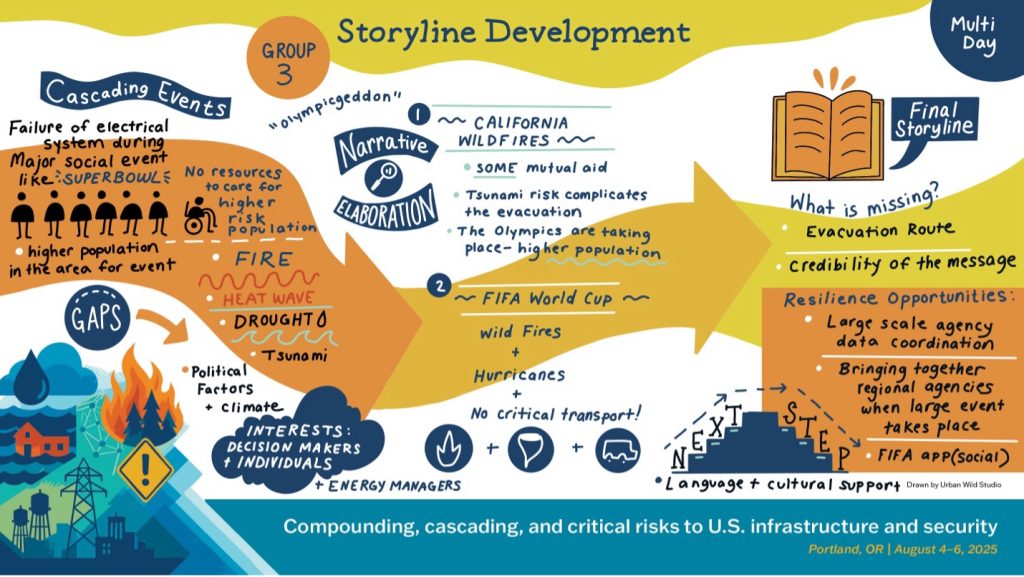
This ~80-person workshop took place in Portland, OR in early Aug 2025 and centered on small groups developing storylines to creatively reveal gaps in knowledge and practice around compound hazards. The format intermingled a few sessions of talks and panels with semi-structured small-group discussions and substantial breaks; midway in formality between the latter two was a first-day “speed dating” session that proved especially popular.
Attendance was drawn approximately half from the physical sciences and half from social sciences, policy/governance, NGOs, and climate-related industries. Conversations ranged over a wide array of topics, emphasizing both the complexity of compound hazards but also the potential for existing tools and capabilities to be more effectively applied through communication among professionals as well as with the public (for example, when encouraging general preparedness or announcing emergency evacuations).
A particular focal point concerned recent compound hazards in the US, such as the Sep 2024 Appalachian flooding from Hurricane Helene and Jan 2025 Los Angeles wildfires, that dramatically upended local risk assumptions and overwhelmed affected communities. Indeed, that certain compound hazards (such as earthquakes and related hazards in the Western US) inspire conscious and concerted planning efforts while others (such as wildfires in the eastern US) are mere afterthoughts, and that these disparities do not always correlate well with objective risk calculations, especially under climate change, was a recurring motif. Another important realization surrounded the existence of points of failure, such as the power grid, whose criticality in supporting multiple levels of preparedness, resilience, and recovery across health, economic, and other impacts seems to not be reflected in commensurate maintenance investments.
Despite recruitment efforts, much local and regional knowledge that could have contributed to the discussions was absent, a frequent situation but a major hurdle in developing truly actionable science. Nonetheless, the interdisciplinarity and focus on narratives both supported a certain fundamental unexpectedness of interaction that helped sustain engagement over the full three days.
The above themes were developed to a significant degree through the storyline exercises, and were summarized through notes (to serve as the basis of a fuller write-up) as well as graphic recordings, illustrated in the below figure. The workshop website will remain up to showcase further outcomes as they develop.
Genuine appreciation is extended to NSF for remaining committed to sponsoring this gathering.